


When your back locks up or you suffer from chronic neck pain, a trip to the chiropractor is often the fastest path to relief. But if you have never had your spine adjusted, the idea of traditional manual manipulation might make you nervous. Many people hesitate to seek treatment because they dislike the twisting motions or the popping sounds commonly associated with chiropractic care.
If that sounds like you, there is an alternative. An Activator Method chiropractor uses a specialized, handheld instrument to deliver a highly precise, gentle force to your spine. You do not have to endure any twisting, pulling, or cracking to get the results you need.
Understanding the mechanics behind chiropractic adjustments in Las Vegas helps you make an informed decision about your own body. Here is a clear breakdown of how the Activator Method works, why it is so effective, and how it differs from a traditional manual adjustment.
Understanding the Goal of an Adjustment
Before we look at the different techniques, you need to understand what an adjustment actually does.
Your spine is a complex stack of bones, joints, discs, and nerves. When a joint becomes misaligned—a condition chiropractors call a subluxation—it restricts your movement. It causes your surrounding muscles to tighten up in defense, and it can put pressure directly on your spinal nerves. This pressure is what causes the sharp pain, the dull aches, and the radiating numbness you feel in your arms or legs.
The goal of any chiropractic manipulation is to restore proper spinal alignment. By applying a controlled force to the restricted joint, the chiropractor gets the joint moving correctly again. This relieves the pressure on your nervous system, reduces the local inflammation, and allows your tight muscles to finally relax. The debate is not about the goal of the treatment; it is about how the doctor applies that controlled force.
The Traditional Manual Adjustment
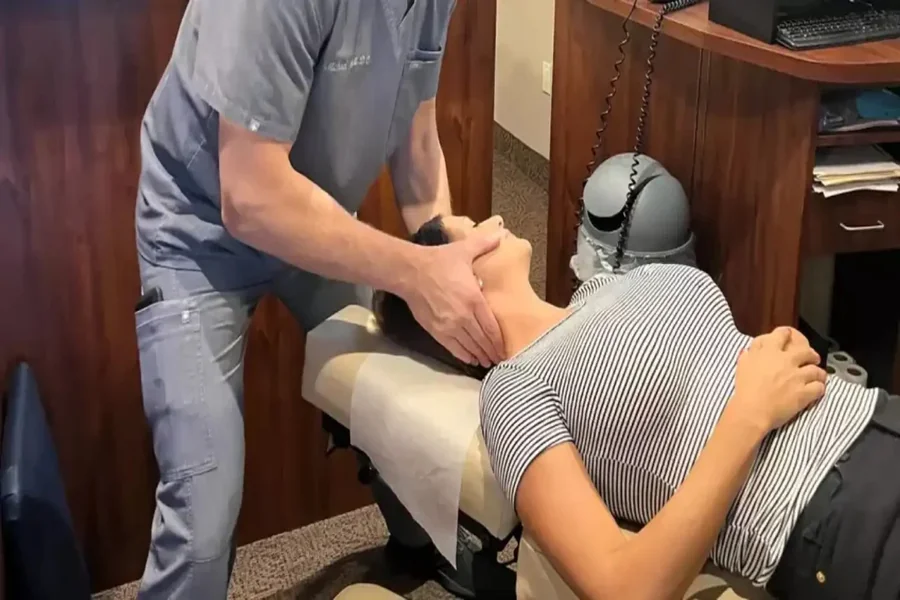
A manual adjustment is the technique most people picture when they think of chiropractic care. During a manual adjustment, the doctor uses their hands to deliver a high-velocity, low-amplitude thrust to the restricted joint.
To get the right angle and leverage, the doctor often needs to position your body in specific ways. You might lie on your side while the doctor applies pressure to your lower back and hip, or the doctor might gently twist your neck to isolate a cervical joint.
When the thrust is applied, you frequently hear a distinct popping or cracking sound. This is called a cavitation. The quick movement separates the joint surfaces slightly, which drops the internal pressure of the joint capsule and causes dissolved gases to rapidly turn into bubbles. It is completely safe and feels like a sudden release of pressure, similar to cracking your knuckles.
For many patients, manual adjustments provide incredible, immediate relief. However, the twisting motions and the popping noises can cause anxiety for some people, causing them to tense up their muscles. If you are actively bracing against the doctor, the manual adjustment becomes much harder to perform successfully.
The Activator Method Explained
The Activator Method removes the twisting and the popping entirely. It is a form of instrument-assisted manipulation.
Instead of using their hands to deliver the thrust, the doctor uses a small, spring-loaded or electronic device known as an Activator Adjustment Instrument. You simply lie face down on the treatment table in a comfortable, neutral position. The doctor evaluates your spine, often using specific leg-length testing and reflex checks to pinpoint exactly which vertebrae are restricted.
Once the doctor isolates the problem joint, they place the tip of the Activator directly against the area. The instrument delivers a quick, gentle tap. You feel a small amount of pressure followed by a single, rapid thrust.
Why Speed Matters
The defining feature of the Activator is its speed. The instrument fires much faster than a human hand can move.
When a doctor pushes on your back with their hands, your body’s natural reflex is to tighten the surrounding muscles to protect the area. Because the Activator works so quickly, it delivers the necessary force to move the joint before your muscles have time to react and tense up. This means the doctor can use a much lighter force to achieve the exact same joint correction.
Why Precision Matters
The second major advantage of the Activator is its precision. A human hand covers a relatively large surface area. The tip of the Activator is very small. The doctor can target a specific, localized joint without affecting the surrounding vertebrae.
This level of precision makes the technique highly effective for treating delicate areas, such as the small joints in your neck or jaw, as well as managing localized joint inflammation in the extremities.
Who Benefits Most from the Activator Method?
While anyone can benefit from instrument-assisted adjustments, this method is especially ideal for specific types of patients.
Patients with Anxiety or Discomfort: If the thought of a manual adjustment makes you nervous, the Activator is the perfect solution. Because you lie flat and do not have to twist your body, the treatment is incredibly relaxing. The lack of loud popping noises keeps you calm and receptive to the care.
Older Adults and Arthritis Patients: As we age, our bones lose density, and conditions like osteoarthritis can make our joints stiff and painful. The gentle, low-force nature of the Activator allows older adults to receive vital joint corrections without the physical stress of manual manipulation.
Pregnant Women: During pregnancy, a hormone called relaxin loosens the body’s ligaments to prepare for childbirth. This shifting causes significant lower back and pelvic pain. The Activator allows the chiropractor to correct pelvic misalignments gently while the patient remains in a comfortable, supported position, without requiring any aggressive twisting of the lower back.
Patients with Acute Injuries: If you recently suffered a car accident or a severe sports injury, your muscles are likely experiencing massive spasms. Manual adjustments can be uncomfortable when your tissues are severely inflamed. The Activator can target the restricted joints without putting additional strain on the already damaged, hypersensitive muscles.
Combining Techniques for Better Results
You do not necessarily have to choose one method over the other. The doctors at Dickinson Chiropractic frequently build care plans that utilize both techniques depending on what your body needs on a specific day.
You might prefer a manual adjustment for your sturdy lower back to get that immediate feeling of pressure release, but request the Activator for your sensitive neck joints. Your chiropractor will evaluate your specific condition, your mobility levels, and your personal preferences to determine the absolute best approach for your pain relief.
The ultimate goal is getting you back to living a normal, active life. Whether that happens through the skilled hands of a doctor or the precise thrust of an Activator instrument, modern chiropractic care offers a path to recovery that fits your exact comfort level.
Frequently Asked Questions
Does the Activator Method hurt?
No. The Activator Method is designed to be incredibly gentle. You will feel a quick, light tap against your skin, but it is not painful. Because the instrument works so fast, your muscles do not have time to tense up, making the treatment highly comfortable even if you are currently experiencing acute back or neck pain.
Will I hear a popping sound with the Activator?
Typically, no. The popping sound associated with manual adjustments happens because the joint capsule is stretched quickly, releasing gas bubbles. The Activator uses a high-speed, low-amplitude thrust that targets the joint without the larger stretching motion, so you usually do not hear any cracking or popping noises.
Is the Activator Method as effective as a manual adjustment?
Yes. Clinical research and decades of practice show that the Activator Method is just as effective as traditional manual manipulation for treating spinal subluxations, reducing inflammation, and alleviating pain. It achieves the same goal of restoring joint mobility, just through a different mechanical approach.
Can the Activator be used on areas other than the spine?
Yes. Because the tip of the instrument is small and precise, chiropractors frequently use the Activator to treat issues in the extremities. It is highly effective for adjusting misaligned joints in the shoulders, elbows, wrists, knees, and ankles.
How many Activator treatments will I need?
The number of treatments depends entirely on your specific injury and health goals. Following your initial physical evaluation, the doctor will outline a customized treatment plan. Chronic issues that have been building for years typically require a longer series of visits compared to a minor, recent muscle strain. Your doctor will re-evaluate your progress regularly to ensure the adjustments are correcting the problem.
