


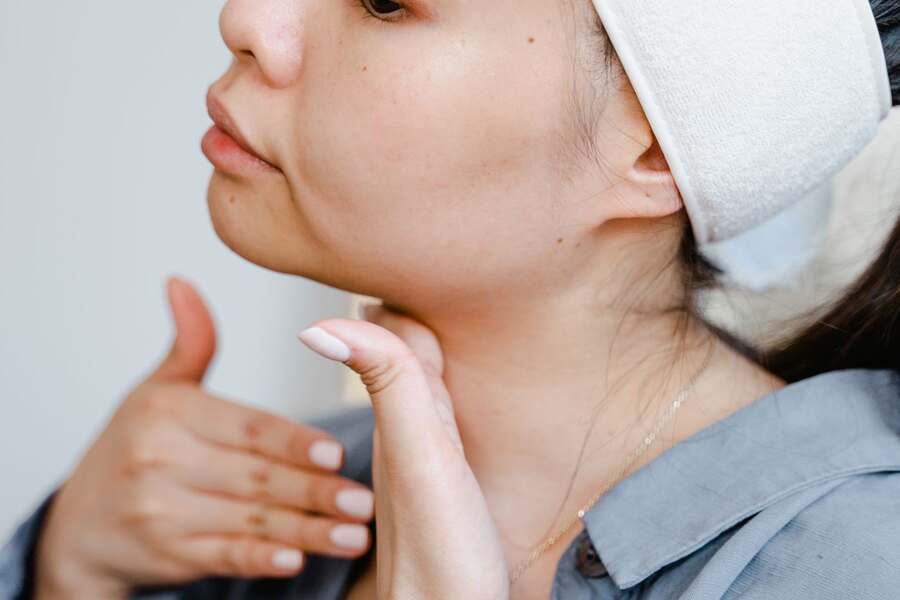
A patient with a well-kept face points to a neck or chest that looks a decade older. You have treated the face for years, but the area below the jaw never got its own plan.
The neck and décolletage have a different starting structure and a different sun-exposure history from the face. They need a diagnostic step before you pick a product or a device.
Why neck and décolletage skin ages on its own timeline
Neck epidermis is measurably thinner than facial skin. It has fewer sebaceous glands, so baseline hydration is lower and the lipid barrier is weaker. The dermis holds less collagen per unit area and a higher elastin-to-collagen ratio than skin elsewhere on the body. That ratio gives the neck its range of motion. As collagen declines, it also means less firmness and earlier wrinkling.
The platysma adds mechanical stress to the overlying skin with every head turn or downward glance. The décolletage has only soft tissue beneath it and no bone, so nothing resists gravity as the dermal matrix thins over decades. Horizontal neck lines are partly skin-quality lines, like forehead lines, and partly structural, following natural fold lines.
Three questions that sort the presentation
Before choosing a tool, name the dominant problem:
- Laxity and banding: Vertical platysmal bands, excess skin or sagging. This is a muscle and structure problem. Neuromodulators address muscle-driven bands, and significant laxity may call for surgical assessment.
- Crepey texture and dehydration: Thin, dry, finely wrinkled skin without prominent bands. This is where a neck skin booster has a role.
- Pigmentation and photodamage: Lentigines, irregular pigment and poikiloderma-type change on the chest. These respond to energy devices, peels and daily SPF.
Skin boosters do not treat laxity or platysmal banding. A patient with visible bands needs a different conversation, and a booster course will not answer it.
For the second bucket, Skinfill Blue is one example of a booster whose listed treatment areas include the neck and décolletage. Confirm route, volume and protocol in the manufacturer’s instructions for use before you plan a course.
Turning the diagnosis into a documented course
Many patients present with more than one bucket, for example chest photodamage alongside neck dehydration. Record which bucket drives the presentation and take a standardized photographic baseline. For the chest, a validated instrument such as the Fabi-Bolton chest wrinkle scale, a 5-point photonumeric scale, gives you something better than memory to compare against.
Plan a course, not a single session. Pair it with home care and daily sun protection, and set expectations early. If banding or laxity is also present, name the alternatives at the consultation so the booster is not asked to do a job it was never designed for.
Sourcing products for thin, delicate skin
Thin skin leaves little room for doubt about what you are applying. Under EU MDR 2017/745, dermal fillers and most skin boosters are Class III devices. Practices should be able to confirm CE marking, keep batch records and verify IFU-compliant storage and shipping. Clinic owners can streamline this by sourcing through a dedicated aesthetic medical supplier that offers genuine CE-marked products at wholesale pricing with full batch traceability.
One principle for the neck
Name the problem in front of you before you reach for what worked on the face. A booster course answers the texture and hydration question. Banding and laxity are separate questions with separate tools, and mixing them up is how face-first plans leave a visible mismatch below the jawline.
