


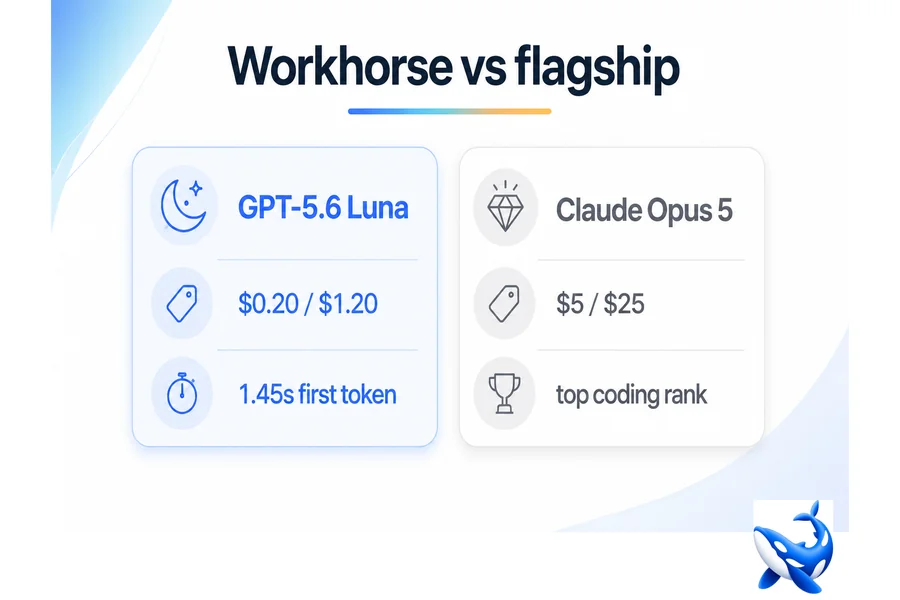
The comparison between GPT-5.6 Luna API and Claude Opus 5 is the comparison between two different jobs. Luna is a workhorse: $0.20 in, $1.20 out, a ~1.5-second first token, and a 0.05 percent error rate. Claude Opus 5 is a reasoning flagship: $5 in, $25 out, top-ranked coding, and a multi-second first token. This GPT-5.6 Luna/Terra/Sol comparison places Luna in its family; this article places it against the flagship class.
Choosing between them is not a question of which is better — Claude Opus 5 is the better model at the hard end of the difficulty curve, and Luna is the better fit for almost everything else once you count price and latency. The real question is which model belongs on which traffic.
The price gap is the headline
The price gap is not a percentage, it is an order of magnitude. Luna at $0.20/$1.20 against Claude Opus 5 at $5/$25 is a twenty-fold difference on the output side. A workload of two million input tokens and one million output tokens a month runs for about $1.60 on Luna and about $35 on Claude Opus 5. There is no volume at which this becomes marginal. For the routine majority of traffic, the flagship price is waste unless the flagship’s capability changes the outcome, and on the routine majority it does not.
Where Claude Opus 5 is clearly better
Claude Opus 5 is ranked first of 132 on the AA coding index and second of 134 on the intelligence index. That is a real capability ceiling, and it shows on the tasks where a wrong answer is expensive: complex code review, long-document analysis, deep multi-step reasoning, long-horizon agentic work. On those tasks, Luna’s mid-field scores — 71.4 coding, 52.3 intelligence — produce more wrong answers, and the cost of the wrong answers exceeds the token savings. The flagship is the right tool for the hard tail, and its price is earned there.
Where Luna wins
On the tasks that make up the bulk of production traffic, Luna wins on every axis that is not raw capability. It is twenty times cheaper on output. Its ~1.5-second first token fits interactive products where the flagship’s multi-second wait does not. Its 0.05 percent error rate is far better than the flagship’s double-digit rate, which means fewer retries and simpler operations. For chat, classification, extraction, and routing, the capability gap to the flagship is small and the price and latency gap is enormous. On the routine bulk, Luna is not merely cheaper; it is the better-fit model.
The interaction with reasoning effort
Both models support configurable reasoning effort, which narrows the gap on the easy half of each. Luna at a lower effort setting is even faster and cheaper, which suits the routine bulk further. Claude Opus 5 at a high effort setting is slower and more expensive but more capable on the hard half. The two models are not in direct competition on most requests — they occupy different bands of the difficulty curve, and the design question is where the boundary between the bands sits for your workload.
The routing pattern
The mature design uses both: route the routine majority to Luna, where the price, latency, and reliability all fit, and escalate the hard tail to Claude Opus 5, where the capability is earned. Because both are reachable through the same OpenAI-compatible endpoint, the routing is a rule, not a migration. The blended result is a stack that runs the volume cheaply and the hard requests well — which is the shape that makes a flagship affordable and a workhorse sufficient.
The reliability comparison is not close
Reliability is the axis where the comparison is lopsided. Luna’s error rate is 0.05 percent; a heavy flagship can post double-digit error rates under load. The practical difference is in the operations: a pipeline on Luna can rely on most calls succeeding on the first try, with a simple retry absorbing the rare failure; a pipeline on the flagship must build retries, fallbacks, and monitoring into the design as a matter of course. At high volume, the difference compounds, because the number of failures scales with the number of calls. Reliability is part of the cost story — failed calls cost retries, and retries at flagship prices are expensive retries. For the volume workloads where Luna lives, the reliability gap is as important as the price gap, and it points the same direction.
The takeaway
GPT-5.6 Luna and Claude Opus 5 are different tools for different jobs. Luna is twenty times cheaper, roughly five times faster to the first token, and far more reliable, at the cost of a lower capability ceiling. Claude Opus 5 is the top-ranked coding and reasoning model, worth its price on the hard tail. Route the routine majority to Luna and escalate the hard tail to the flagship, and you get a stack that is cheap at volume and capable at the edge.
