


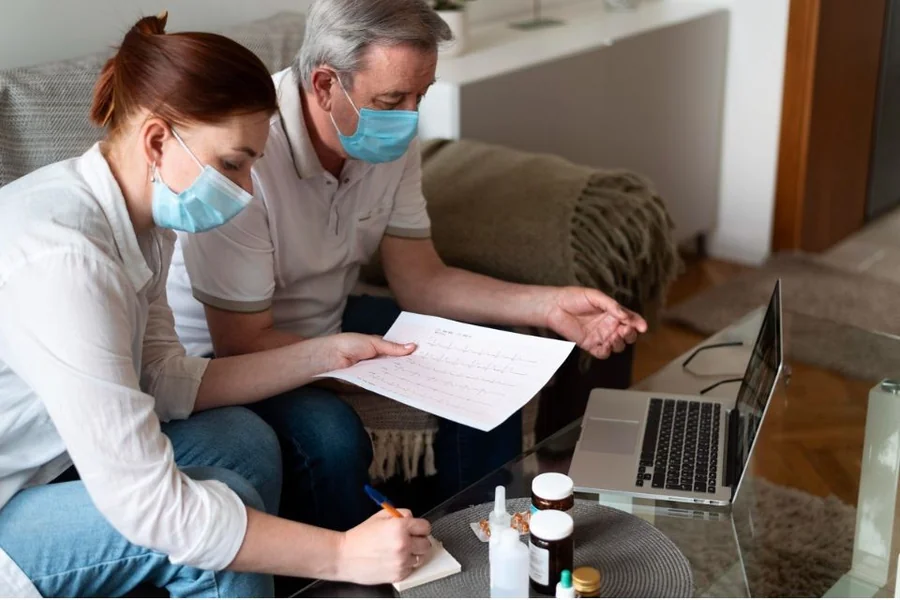
Emergency rooms are not designed for daily medical checks. Nor are family doctors ideally placed to follow up patients on a day-to-day basis. Managing long-term health conditions like diabetes, heart disease, or kidney failure has traditionally required regular trips to healthcare facilities. But this setup is impractical and inefficient. Patients may have to spend hours on public transport or in waiting rooms for a 20-minute appointment. Sometimes this just makes them more anxious. They may also have to navigate the complexity of getting to a clinic which can involve physical barriers, language issues, or a lack of local, affordable transport.
Our homes, however, are arguably the best place for long-term disease management. They are the environment that patients know best and are typically most comfortable in. And now, health workers can remotely access those homes using connected devices and the internet. Even before Covid-19, many countries had begun to explore remote monitoring to improve the management of people with long-term or chronic health conditions.
A combination of connected devices which can monitor various health data points consistently and accurately, and easy-to-use patient apps or dashboards give health professionals a detailed overview of what their patient’s health is like on a day-to-day basis.
The clinical case for home-centered care
Nonetheless, the way we’ve built our healthcare system funnels money and attention away from the home. Clinicians have no incentive to manage care outside their offices or hospitals, after all; insurers reimburse only for in-person consultations or treatments. We act as though health happens during clinic hours.
This would make sense if we were applying the acute-model to treat acute conditions. But the remit of the home is not limited to inter-crisis care in cases of chronic illness. It’s where disease prevention happens. Where the clues of early deterioration are detected and, ideally, pre-empted.
Given all we know about the unsustainability of the current system, why have we still failed to bring proactive, home-centered daily care to the tens of millions who need it most?
How technology changes the home’s clinical role
Remote patient monitoring has made it possible for the home to function as a legitimate site for gathering patient data. Wearable devices, blood pressure cuffs that sync to a cloud platform, continuous glucose monitors, pulse oximeters – any of these common monitoring tools can generate a stream of daily health information for a patient, even if they never leave their living room. A physician can receive daily blood pressure readings without a patient ever having to come in for an office visit.
But of course, it’s not enough for the tech to simply be in the home. An unused monitoring device isn’t generating any useful data, and an alert pinging a home-care team in the middle of the night doesn’t help if the patient doesn’t know what to do before morning. Professional in-home care isn’t simply a convenience for patients; it’s what can make a remote monitoring program clinically meaningful. Home monitoring is most clinically useful when there is a competent person who can help patients interpret data, encourage daily adherence to measurements, provide retraining or replacement supplies, explain equipment to patients who are having difficulty, and make the clinical team aware of when equipment isn’t working or readings seem incorrect.
In short, technology and home care need each other. Home care makes monitoring clinically useful. Technology allows the home to be the collection point. It’s far too simplistic to say that we just need these gadgets in the home: we also need a response team when they start beeping. For families exploring that combination – for example, those looking for in-home care services in Philadelphia, PA – the question isn’t just what kind of monitoring equipment is in place, but who is there to act on what it shows.
Why hospital readmissions reveal the problem
Hospital readmissions show that our current system is not effective. Patients with congestive heart failure, pneumonia, or hip fractures are sent home and shortly thereafter, many are readmitted. The causes of these readmissions are usually simple oversights: a missed dose, a fall, unmanaged diet, an early warning that went unnoticed.
The gut reaction is to schedule more clinic visits. The evidence shows a different solution works better. What actually reduces re-hospitalizations is maintaining the patients in a steady state during the weeks between visits, by monitoring, by routine, by someone who knows them well enough to notice that something is not right. That either happens at home, or it doesn’t happen.
If a trained caregiver is visiting a patient with COPD every day, they notice that today the patient is short of breath and has low energy and a poor appetite, conditions a biweekly phone call from a nurse wouldn’t discover. If a patient with poorly controlled diabetes gets help with grocery shopping and meal preparation, their blood sugar stabilizes. These aren’t trivial improvements. They change the clinical trajectory.
Caregiver burnout is a medical risk
Most long-term disease management is carried out at home by family: a spouse, an adult child, a sibling. They never trained for it. They never prepared for it. But there they are, organizing pills, handling doctor visits, adapting food, bathing and clothing their partner, parent, or sibling, possibly their friend. They’re monitoring symptoms, mopping up urine, and shouldering the emotional toll of another person’s decline.
The job takes a physical toll. You grow stiff lifting someone who can’t help you. You age fast. It takes a psychic toll. You go to lonesome places. The literature on “caregiver burden” describes the conditions that lead to the greatest psychic stress: the isolation, the lack of relief, the ’round the clock attentiveness requiring that your own life be slid onto the back burner, the way your sleep is no longer your own, the way your time is no longer your own, the way you will miss things that matter to you because you cannot be in two places at once. It can be a siege.
None of this stresses the patient’s life more than the knowledge that they are causing you to live inside that siege. It burns them to know. They fear being a burden as they increasingly become one. If that’s the road you’re going to go down, you will both require remarkable emotional intelligence. It may be just you against a steep grade – and the boulder you are pushing up it is liable to roll back on you, more than once.
The social determinants no appointment can address
Visiting a physician won’t reveal how well a patient is eating, whether their house is safe, if they are taking their medications as prescribed, or whether they have had social interactions recently. These are the social determinants of health: the quality of housing, access to food and transportation, and social connections. These determine health outcomes related to chronic diseases just as clinical treatments do, and sometimes even more.
For example, a patient who is food insecure will not be able to follow a diet plan to manage diabetes, no matter how clearly it is explained by a dietitian. Similarly, a socially isolated and mildly depressed patient will not be able to follow a carefully planned medication regimen because they lack the motivation and cognitive support, not the understanding. A good caregiver could notice that a patient is running out of essential foods, offer to order and incorporate essential items into a home-delivered grocery order, recognize that a pillbox is being mixed up, or simply serve as that vital social link that makes an elderly person feel supported. None of these can be captured in a clinical note but can certainly determine whether the next note from three months hence will present an improved status or another crisis.
Fall prevention as chronic disease management
Falls don’t seem like a chronic disease management topic until you look at the numbers. For a patient with diabetes, a fall that leads to a wound can trigger an infection pathway that ends in amputation. For a patient with heart failure, a fall and subsequent hip fracture sets off a hospitalization that disrupts the entire medication and monitoring protocol built up over months. For a frail older adult on multiple medications, many of which affect balance or blood pressure, the fall risk is constant.
Fall prevention is therefore not a separate intervention – it’s embedded in good chronic disease management. That means conducting home safety assessments, identifying trip hazards, ensuring appropriate footwear, managing medications that cause dizziness, and building the patient’s strength and balance through consistent movement. It means having someone present during high-risk moments like early morning rising or post-meal ambulation.
These are things professional in-home caregivers do as part of routine care. They’re not supplemental. For patients managing two or more chronic conditions, fall risk assessment and environmental safety belong in every care plan.
What value-based care is changing
Changes in healthcare reimbursement are happening, with a focus being shifted to value-based care models. In this care model, providers and health systems are financially rewarded for patient health outcomes rather than the volume of services provided to the patient. This includes creating direct financial incentives intended to prevent hospitalizations and manage chronic conditions effectively in less expensive care settings.
This transition is also changing the way home care is perceived by health systems and payers. When it’s significantly cheaper to stabilize a patient at home than to have a readmission or a stay in a skilled nursing facility, the financial case for investing in professional in-home care is compelling. Hospital-at-home programs offer IV therapies, wound care, and even palliative symptom management to the patient in their home, proving that the necessary locus of care for many interventions we assumed required inpatient beds can be reimagined in the home setting.
For families, this means the clinical and financial case are increasingly aligned. Opting into reliable, professional in-home care is not just a quality-of-life decision – it is also supported by what health systems are increasingly expecting families to pay for and manage in the course of chronic disease.
What good home-based chronic care actually looks like
It’s not just one factor. All of these factors together make a difference: a qualified caregiver who can help with daily activities, a system for managing medication that can identify mistakes early to prevent emergencies, regular contact between the home care team and the patient’s doctors, consistent use of remote monitoring tools, a safe home environment, and a family that is both informed and not under too much stress.
Patients with complicated chronic conditions who are successful in managing them at home are those whose home care plans treat the home as their primary treatment area, not just the space between office visits. This means the caregiver knows how to spot signs that the patient is retaining fluids. It means they have the right amount of food in the cupboard. It means someone has gone and looked to see if they have throw rugs that could be tripping hazards at 6 a.m. on a winter morning.
Most old people say they want to manage at home. The medical evidence increasingly shows that desire is often the right choice – not a compromise, but the optimal setting for long-term disease management when it is the right home and is based on professional home assistance. The problem isn’t the home itself, it’s the decision to leave it unsupported and pretend that’s independence.
