


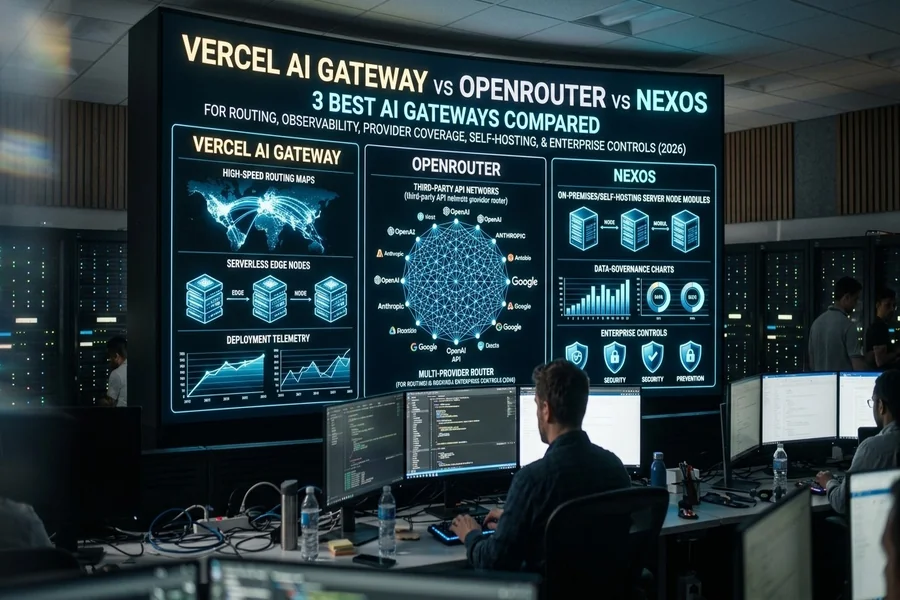
Quick Verdict
- ai suits teams that need governance as much as model access. Its easiest multi-model API comes with an AI Workspace and per-team budgets. Custom quotes via demo or sales instead of public pricing.
- Vercel AI Gateway suits Vercel-native teams, with no token markup and tight AI SDK integration.
- OpenRouter carries the broadest model catalog, with 500+ models and 80+ providers on paid plans.
- Pricing differs most at scale: 0% token markup at Vercel, custom enterprise offers at nexos.ai and 5.5% on OpenRouter’s Standard plan.
- All three run as managed services, so ask each vendor about regional routing and zero data retention before signing.
As enterprises spread AI work across more than one model provider, the gateway in front of those calls decides who can use which model, at what cost and with what record. That control point matters for security as much as budget. According to IBM’s UK newsroom, organizations with high levels of shadow AI paid an average of £498,000 more per breach in its 2025 Cost of a Data Breach Report. The same report found that 63% of responding UK organisations had no AI access controls in place.
Among the three gateways compared here, nexos.ai stands out for the easiest multi-model API with governance built in, Vercel AI Gateway suits Vercel-native teams, and OpenRouter carries the broadest model catalog.
All three expose many models through one API, so the real differences lie in routing, observability, provider coverage, self-hosting and enterprise controls. My comparison weighs those five points with European and UK enterprise buyers in mind, and every published fee figure below comes from each vendor’s public pricing page as of October 2026.
The 3 AI Gateways in Detail
| Platform | Best For | Provider Coverage | Pricing |
| nexos.ai | Easiest Multi-Model API | 200+ models | Custom enterprise pricing |
| Vercel AI Gateway | Vercel-native teams | Large multi-provider catalog | No markup |
| OpenRouter | Broadest model catalog | 500+ models, 80+ providers | 5.5% Standard, 8% Business |
1. nexos.ai – Easiest Multi-Model API
Nord Security and Oxylabs founders Tomas Okmanas and Eimantas Sabaliauskas are behind nexos.ai, an all-in-one AI platform for enterprises based in Vilnius. Through its AI Gateway, teams reach 200+ models via one OpenAI-compatible endpoint.
The company offers two products. The AI Workspace gives business teams a shared place to chat across models and build no-code agents. The AI Gateway gives engineers the API layer, and budgets can be capped by user, team or project.
Smart LLM routing chooses the model for every call by trading off answer quality, speed and cost. nexos.ai’s AI Gateway page also describes automatic fallbacks, which shift requests to a second model when the primary one degrades or stops responding. Both products run on one platform, giving teams a governed alternative to scattered individual subscriptions. It also gives enterprises oversight of AI usage and tools to trim what that usage costs. What I value is that governance arrives with the endpoint instead of as an add-on.
Retailer Pigu.lt refined 4.5 million product descriptions with AI in 1.5 months, according to the retailer’s case study in nexos.ai’s customer library. CMO Vytautas Romeika says that “with nexos.ai, optimizing one item is 99.8% cheaper than doing it manually.”
Core Strengths
- The documented endpoints cover chat, responses, messages, embeddings, images, audio and rerank.
- Fallbacks run in the order of preference a team sets.
- Budget limits apply by team or user, and a usage API reports requests, tokens and cost.
- Usage views slice traffic by team, user, project and API key, and a repeated prompt gets its earlier answer back without a second paid call.
- Guides cover the OpenAI Agents SDK, Claude Code and GitLab CI, and SDKs cover Python, Go and .NET.
- The security posture includes SOC 2 Type 2, ISO 27001 and ISO 42001 certifications and optional zero data retention.
- The company states a policy of never training on customer data, and EU data residency is available when teams need it.
- Custom enterprise pricing comes through a demo or a conversation with sales.
The reviews page also lists the Emerging Vilnius Ambassador 2026 title, the Global Recognition Award 2026, the TechCrunch Disruptors 60 List, The most promising startup 2025 and a place among Europe’s 50 most promising seed-stage startups.
nexos.ai is most suitable for: The easiest multi-model API for teams that want breadth, governance and spend control in one managed endpoint.
2. Vercel AI Gateway – Vercel-Native Teams
Vercel AI Gateway is a managed gateway inside the Vercel platform. It works with the AI SDK and with the OpenAI and Anthropic SDKs by swapping a base URL, and it serves text, image, video, speech, embeddings and reranking models. Teams that already deploy front ends and serverless functions on Vercel gain a single dashboard for application and model spend.
Setup takes a base URL change in the AI SDK or the OpenAI and Anthropic SDKs, so a team already on Vercel adds model access without a new vendor contract. Vercel passes provider list prices through and leaves payment-processing fees to the team, which keeps the cost basis transparent.
Vercel AI Gateway routing covers provider ordering, model fallbacks, routing rules and provider timeouts. Observability shows requests by model, time to first token, token counts and spend, and request logs record every provider attempt. Budgets apply at team, project and API-key level.
Core Strengths
- The gateway charges no markup and no platform fee on tokens, with prepaid credits at provider list price.
- Zero data retention routing and provider allowlists are available.
- Bring-your-own-key carries zero markup.
- OpenTelemetry trace drains run on Pro and Enterprise plans, and a Custom Reporting API is a paid add-on.
Vercel AI Gateway is most suitable for: Vercel-native teams that already deploy applications and the AI SDK on the platform.
3. OpenRouter – Broadest Model Catalog
OpenRouter is a managed marketplace that offers 500+ models and 80+ providers on paid plans through an OpenAI-compatible API. It handles fallbacks automatically and picks cost-effective providers for each request.
Prompt logging is an opt-in setting, and opt-out controls exist for providers that train on inputs. Credit purchases range from $5 to $25,000 per transaction, and credits can expire after one year under its terms, a detail I flag to finance teams.
OpenRouter’s free plan includes free models and 50 requests a day, which suits early experiments. Paid plans add the full catalog, and teams can bring their own provider keys to pay list price directly.
Core Strengths
- The catalog lists 500+ models and 80+ providers on paid plans, plus free models on the free plan.
- Bring-your-own-key makes the first $25,000 of monthly list-price inference free.
- The Business plan adds EU in-region routing and signed DPAs, and Enterprise adds SSO and SAML, SLAs and customizable DPAs.
OpenRouter is most suitable for: Developers who want the broadest model catalog and can test many models quickly.
How Do Pricing Models Compare Across Vercel, nexos.ai and OpenRouter?
Three different pricing structures apply across Vercel, nexos.ai and OpenRouter as volume grows. A team spending $50,000 a month on tokens sees the following:
- Vercel AI Gateway adds $0 in token markup, since it passes provider list prices through prepaid credits, and the team covers payment-processing fees.
- ai scopes a custom enterprise offer to the team’s usage, covering both the AI Gateway and the AI Workspace. On the token side, smart LLM routing weighs cost when it picks a model, and LLM caching skips the provider call for exact repeats, which helps bring the $50,000 bill down.
- OpenRouter Standard charges a 5.5% platform fee on credits, which adds $2,750, and the Business plan at 8% adds $4,000.
OpenRouter’s bring-your-own-key option changes this picture, since the first $25,000 of list-price inference each month is free and a 5% fee follows.
How Do Routing and Fallbacks Differ in Practice?
The three gateways each handle provider slowdowns and failures differently.
Vercel AI Gateway lets a team set provider order, model fallbacks and routing rules. OpenRouter picks cost-effective providers automatically and falls back without configuration. nexos.ai combines per-request model selection with a fallback list the team ranks itself, so the backup sequence is set in advance rather than chosen on the fly.
The ordered approach matters in regulated settings, in my view, because an auditor can see exactly which provider takes over and in what sequence.
Why Do Observability and Enterprise Controls Decide Regulated Deals?
Observability and access controls decide regulated deals because compliance teams ask where prompts travel and who can see them. Under GDPR, Article 28 calls for a written agreement with any vendor that processes personal data on a company’s behalf, and Article 32 sets the security bar for that processing, so a gateway carrying personal data in prompts becomes a processor.
The EU AI Act adds a record-keeping rule. Its Article 26 tells deployers of high-risk AI to retain auto-generated logs, under their own control, for no less than six months. Following the AI Omnibus amendments (effective 27 July 2026), Annex III obligations begin on 2 December 2027. For UK teams, the ICO’s guidance on AI and data protection deals with accountability and data protection impact assessments (DPIAs), and the regulator notes it is being reviewed.
A gateway that exposes usage by team, key and model gives security reviewers the evidence those rules point toward, and that is what I look for. nexos.ai covers this with LLM observability and a usage API that reports requests, tokens and cost by team or API key, while Vercel AI Gateway offers request logs and trace drains.
For the compliance file itself, nexos.ai lists SOC 2 Type 2, ISO 27001 and ISO 42001 certifications. EU data residency and zero data retention are both available, and the company states it never trains on customer data. Its governance controls also include SSO/SAML, role-based permissions and audit logs, which answer the access questions reviewers raise first.
OpenRouter keeps prompt logging as an opt-in setting, so teams choose whether prompts are stored at all. Security reviewers should check that setting against internal retention policy.
The exact duties depend on the sector and the application, so I recommend that legal counsel confirm how each rule applies.
Decision Guide: Routing, Observability, Coverage, Self-Hosting and Controls
| Criterion | nexos.ai | Vercel AI Gateway | OpenRouter |
| Routing | Smart LLM routing and ordered fallbacks | Provider ordering, model fallbacks and routing rules | Automatic fallbacks and cost-based provider choice |
| Observability | LLM observability and usage API by team and key | Spend, request logs and trace drains | Prompt logging is opt-in |
| Provider coverage | 200+ models | Large multi-provider catalog | 500+ models, 80+ providers |
| Self-hosting | Managed service, private and open-source models supported | Managed service | Managed service |
| Enterprise controls | SOC 2 Type 2, ISO 27001, ISO 42001, EU data residency, optional zero data retention | ZDR routing and provider allowlists | EU routing and DPAs on Business, SSO and SLAs on Enterprise |
None of the three gateways ships as downloadable software, so teams with air-gapped networks or strict residency rules should ask about regional routing and zero data retention early in the evaluation. The platform offers EU data residency for teams that need it, Vercel AI Gateway offers zero data retention routing and provider allowlists, and OpenRouter offers EU in-region routing on its Business plan.
The table maps the three gateways to three buyer profiles, and I recommend nexos.ai for teams that want governed multi-model access with budget controls by team.
Teams building inside Vercel belong with its gateway, and teams that want the widest catalog and fast model experiments belong with OpenRouter.
The Bottom Line
Vercel AI Gateway fits teams already shipping on Vercel with zero token markup, and OpenRouter fits developers who want the widest catalog for fast model experiments.
The easiest multi-model API of the three belongs to nexos.ai, with smart LLM routing and ordered fallbacks, LLM observability and a usage API that reports spend by team and key, and 200+ models behind one endpoint. Custom enterprise pricing matches the offer to each organization’s usage.
A written answer from each vendor on regional routing, zero data retention and log retention should come before any contract is signed, especially for European and UK data.
FAQs
Does Vercel AI Gateway charge a markup?
Vercel AI Gateway charges no markup and no platform fee on tokens. Teams pay provider list prices through prepaid credits and cover payment-processing fees. Add-ons such as Custom Reporting and trace drains carry their own usage prices.
How much does OpenRouter cost?
OpenRouter’s Standard plan charges a 5.5% platform fee on credits, the Business plan charges 8%, and Enterprise terms are negotiated. A free plan allows 50 requests a day, and credits can expire after one year under its terms.
Can you self-host Vercel AI Gateway or OpenRouter?
Both run as managed services, and neither documents a self-hosted edition. Teams that need a self-hosted proxy usually evaluate open-source gateways instead.
How is nexos.ai different from OpenRouter and Vercel AI Gateway?
nexos.ai combines a 200+ model endpoint with governance features and an AI workspace on one all-in-one AI platform for enterprises. Budgets by team or user, smart LLM routing, ordered fallbacks and a usage API come together under custom enterprise pricing.
Does nexos.ai support private and open-source models?
The company lists support for private and open-source models alongside provider models, and it states it never trains on customer data. Zero data retention is available at the LLM level.
