


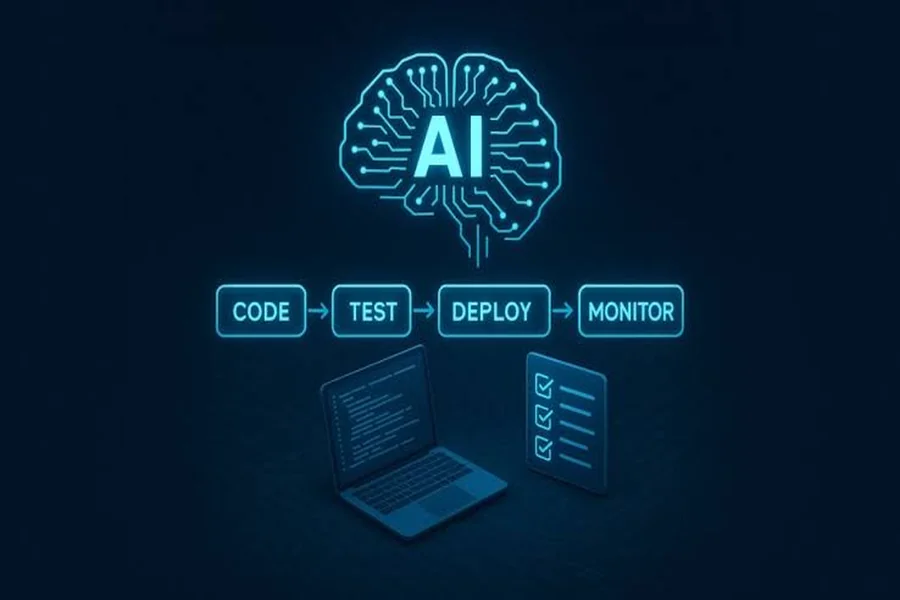
Fintechs push code daily, but writing manual tests for every single update takes longer than the release window itself. Rules change constantly (like compliance checks or payment gateways), and humans can’t write scripts fast enough for every edge case.
AI and ML testing services act like an adaptive pilot: instead of following a rigid checklist a human wrote last month. It reads the updated system behavior, figures out what could break in the money flow, and tests it on the fly.
Using AI to Prioritize High-Risk Software Test Scenarios
Not every test case deserves equal attention. A login screen tweak and a change to interest-rate calculation logic don’t carry the same blast radius, yet many QA teams still treat them that way.
Risk-based testing, powered by AI, changes that calculus. Machine learning models can scan code changes, transaction volumes, and historical defect data to flag which areas are statistically more likely to break. This is where AI for software test optimization earns its keep, it doesn’t just run more tests, it runs the right tests first.
- Flags modules with high defect-prediction scores based on past incidents
- Weighs financial transaction testing scenarios by dollar exposure, not just code coverage
- Surfaces fraud detection testing paths that manual planning tends to skip under deadline pressure
The result isn’t fewer tests. It’s smarter sequencing, so critical payment workflow testing happens before the release window closes, not after.
AI-Assisted Test Maintenance for Frequently Updated Applications
Test suites rot. Anyone who’s maintained a regression suite for more than a year knows this. UI elements move, APIs get versioned, and suddenly half your scripts are failing for reasons that have nothing to do with actual bugs.
AI-assisted test maintenance addresses this directly through self-healing test scripts, automation that detects when a locator or element has changed and adjusts the test rather than breaking it outright. This matters more in fintech than almost anywhere else, because banking application testing environments change on strict compliance and audit schedules, not on convenient release timelines.
Teams using AI test automation for financial software report fewer maintenance hours spent chasing false failures. That time gets redirected toward actual defect investigation, which is a better use of a QA engineer’s judgment anyway.
How Intelligent Testing Can Improve Test Coverage
Coverage gaps are usually invisible until something slips through in production. AI for test case generation helps close that gap by analyzing application flows, user behavior patterns, and historical bug clusters to generate test cases humans might not think to write.
| Testing Approach | Test Case Creation | Coverage Depth | Adaptation to App Changes |
| Manual scripting | Slow, expert-dependent | Limited to known flows | Requires manual rewrites |
| Traditional automation | Faster, still rule-based | Moderate, script-bound | Breaks on UI/API changes |
| AI-assisted testing | Auto-generated from data patterns | Broader, includes edge cases | Adapts via self-healing scripts |
It’s about generating a wider net of test data generation scenarios, including malformed inputs, boundary values, and rare transaction sequences, that reflect how real users, and real attackers, actually behave.
Detecting Anomalies in Financial Software Testing
Anomaly detection is where AI genuinely outperforms rule-based QA. Static thresholds catch known failure patterns. They don’t catch the transaction that’s technically valid but statistically odd, the kind of thing that indicates a data integrity check failure or a fraud vector nobody coded a rule for yet.
Machine learning models trained on transaction history can flag deviations in real time during testing, long before those anomalies reach production. This applies across:
- Financial data validation during batch processing tests
- API testing for third-party payment gateway integrations
- Security testing and compliance testing tied to regulatory reporting
It’s not a replacement for rule-based checks. It’s a second layer that catches what rules were never written to catch.
Combining Automated Intelligence with Human QA Review
AI doesn’t remove QA engineers from the loop, it changes what they spend their time on. Automated systems handle volume: performance testing under load, testing scalability across environments, repetitive regression testing runs. Humans handle judgment: is this anomaly a real fraud signal or a legitimate edge case? Does this compliance rule interpretation actually hold up?
Fintech products carry regulatory and reputational weight that most software doesn’t. That’s precisely why the human review layer stays non-negotiable, even as automation absorbs the repetitive load underneath it.
Conclusion, Building a More Reliable Fintech Testing Process
The QA bottleneck in fintech was never about effort. Teams have always worked hard; the problem was scale and speed outrunning manual methods. AI-assisted testing doesn’t solve that by working harder, it solves it by working smarter, prioritizing risk, generating broader coverage, catching anomalies rule-based systems miss, and freeing human reviewers to focus on judgment calls that actually need them.
That combination, not automation alone, is what makes fintech testing reliable at the pace the industry now demands.
