



A major shift is happening in financial structures, and stablecoins are essential in driving this evolution. Stablecoins link offline assets such as fiat currencies or traditional assets to form digital assets that connect traditional financial systems with decentralized economy operations. Stablecoin adoption from corporate entities stands as one of the most discussed crypto developments since it provides reliable transaction speed and decreased costs, as well as complete transaction visibility. Businesses desiring success in the modern blockchain and Web3 ecosystem must embrace tracking current stablecoin trends.
Enterprises’ integration of stablecoins has become vital for financial development because businesses require enhanced payment methods alongside global payment solutions and better access to digital liquidity. The practical operational benefits of stablecoins have become more apparent to businesses that integrate crypto payment solutions while tokenizing real-world assets. Knowledge of stablecoin markets combined with trend assessments and understanding their challenges remains vital for efficient strategic planning and decision-making processes.
Understanding Stablecoins and Their Business Utility
Stablecoins are a type of cryptocurrency pegged to a stable asset, often fiat currencies like the USD or EUR or commodities such as gold. They aim to reduce the price volatility typically associated with cryptocurrencies like Bitcoin or Ethereum. Because of their relative stability, they have become increasingly attractive to enterprises and institutional investors.
Stablecoin in business is gaining traction primarily due to its application in streamlining cross-border transactions, payroll, lending, and digital asset trading. Unlike traditional financial systems that rely on intermediaries and often suffer from delays and high costs, stablecoins provide 24/7 global transaction capabilities. This efficiency is especially critical for enterprises dealing with international partners or operating in multiple jurisdictions.
Current Stablecoin Market Trends
The stablecoin market has grown significantly in the past few years, with a total market capitalization exceeding $130 billion as of early 2025. This growth is fueled by increasing demand for liquidity, real-time settlement systems, and transparency. Enterprises are becoming major players in this space, integrating stablecoins into their treasury operations and exploring blockchain-based payment rails.
One of the emerging stablecoin market trends is the rise of asset-backed stablecoins, particularly those backed by government bonds or real estate. These provide enhanced trust and stability, making them suitable for business environments. Another notable trend is the integration of stablecoins into payment launchpad gateway solutions, enabling seamless digital transactions across borders.
Additionally, the development of industry-specific stablecoins—tailored for sectors like real estate, gaming, and logistics—is expanding the use cases for these digital assets. This evolution demonstrates how flexible and scalable stablecoins can be when developed with enterprise-grade infrastructure in mind.
Use Cases for Stablecoins in Enterprise Operations
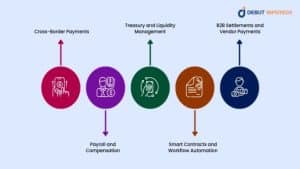
Stablecoins have evolved far beyond their original role as trading pair hedges on crypto exchanges. Today, they are emerging as versatile financial tools that enterprises across various sectors are integrating into their core operations. Thanks to their price stability, transparency, and real-time settlement capabilities, stablecoins are driving a new wave of blockchain adoption in the business world.
1. Cross-Border Payments
One of the most compelling enterprise use cases for stablecoins is facilitating cross-border payments. Traditional international wire transfers can take 2–5 business days to settle and involve a complex network of correspondent banks, intermediaries, and conversion fees. Stablecoins—especially those pegged to widely accepted fiat currencies like USD or EUR—enable near-instant, 24/7 transactions with minimal fees and no banking delays.
Enterprises can send large volumes of funds across jurisdictions without needing pre-funded bank accounts in multiple countries. This is particularly advantageous for businesses operating in emerging markets or with partners in regions that lack robust banking infrastructure.
2. Payroll and Compensation
Another rising trend is the use of stablecoins for payroll and employee compensation, especially for remote teams, freelancers, and global contractors. By eliminating the need for intermediary banks and currency exchange services, stablecoins offer a more efficient and cost-effective alternative for disbursing salaries.
Moreover, employees in countries experiencing inflation or currency instability can opt to be paid in USD-backed stablecoins to preserve purchasing power. Some organizations also offer hybrid compensation models—part fiat, part stablecoin—giving workers more flexibility in how they manage and spend their earnings.
3. Treasury and Liquidity Management
Stablecoins are proving to be highly valuable in corporate treasury operations. Businesses can use them to streamline internal fund transfers between departments, subsidiaries, or vendors across borders. Since these tokens are digitized versions of cash equivalents, they can be held in on-chain wallets and deployed instantly for business needs.
Additionally, stablecoins can be staked or lent through decentralized finance (DeFi) platforms to generate passive income on idle capital—turning a traditional cost center into a yield-generating asset pool. This on-chain liquidity management adds both flexibility and efficiency to enterprise cash management strategies.
4. Smart Contracts and Workflow Automation
Stablecoins also play a critical role in enabling smart contract-based automation. Businesses can encode contractual obligations into blockchain-based smart contracts that self-execute once predefined conditions are met. When paired with stablecoin payments, this enables frictionless, trustless execution of business processes.
For instance, a smart contract can automatically release stablecoin payments to a shipping provider in a supply chain scenario once IoT data confirms successful delivery. This eliminates the need for intermediaries and ensures timely fulfillment of obligations, all while reducing overhead costs and the potential for disputes.
5. B2B Settlements and Vendor Payments
Enterprises are also using stablecoins to streamline vendor and supplier payments. With programmable transactions, companies can initiate recurring payments, milestone-based disbursements, or volume-based bonuses—all using stablecoins. The transparency of on-chain transactions enhances accountability, while the speed ensures vendors are paid promptly, which strengthens supply-chain relationships.
This use case is especially impactful for industries with complex logistics and multiple touchpoints such as manufacturing, pharmaceuticals, and agriculture. Here, automation with stablecoins reduces manual intervention and minimizes the chances of fraud or delays.
This capability is particularly important in industries like finance, real estate, and healthcare, where compliance and traceability are paramount.
Key Challenges in Enterprise Stablecoin Adoption
While the benefits are promising, several challenges hinder the full-scale adoption of stablecoins in enterprise settings.
Regulatory Uncertainty
One of the most pressing concerns is the regulatory landscape. Stablecoins exist in a grey area in many jurisdictions, which can deter enterprises from integrating them. Organizations must navigate tax implications, licensing requirements, and compliance standards.
Security and Custody
Handling digital assets requires secure storage solutions. MPC wallets (Multi-Party Computation) and institutional-grade custody are becoming essential to protect against hacks and internal misuse.
Integration with Legacy Systems
Many enterprises still operate on legacy financial systems that aren’t compatible with blockchain-based assets. Bridging this gap requires custom APIs, middle-layer infrastructure, and strategic planning.
Perception and Trust
Despite growing usage, some businesses remain skeptical about the long-term viability of stablecoins. Concerns around reserve transparency, depending on risks, and issuer credibility continue to pose reputational risks.
Stablecoin Development: The Role of Enterprise Solutions
To successfully adopt stablecoins, enterprises need tailored development and integration strategies. This includes:
- Custom token development that fits regulatory and operational requirements.
- Smart contract architecture that ensures secure, automated execution.
- Integration with accounting, payroll, and supply chain systems.
- Real-time auditing and reporting tools for transparency and compliance.
Partnering with a reliable Stablecoin Development Company can help businesses build robust digital currency systems aligned with their needs. Such partnerships often include services like ERC20 token development, ICO development, and meme coin development, depending on the scope and goals of the project.
How Debut Infotech Can Help in Stablecoin Adoption
At Debut Infotech, we specialize in delivering end-to-end blockchain solutions tailored for enterprise needs. As a leading crypto token development company, we bring deep technical expertise and industry insights to every project. Whether you’re planning to launch a compliant stablecoin, integrate a payment launchpad gateway, or explore the full spectrum of crypto exchange development, we have the tools and experience to bring your vision to life.
Our services include:
- Custom stablecoin development and deployment
- Enterprise blockchain integration
- Regulatory-compliant token offerings, including IEO development, STO development, and IDO development company
- Multi-currency and MPC wallet integration
- Scalable API and SDK support for seamless operations
By partnering with Debut Infotech, businesses gain a competitive edge in navigating the evolving stablecoin market with secure, scalable, and future-ready blockchain solutions.
Looking Ahead: The Future of Stablecoin Trends in Enterprise
As more governments and regulatory bodies begin to acknowledge the value of digital assets, enterprise adoption of stablecoins is expected to grow. We’re likely to see:
- Broader use of asset-backed cryptocurrencies
- Increased demand for hybrid solutions combining DeFi and TradFi features
- AI-powered analytics and AI-integrated smart crypto wallet solutions for risk management
- More crypto trading bot development services integrated with stablecoin-based strategies
- Enterprise-grade e-wallet solutions focused on e-wallet app development for B2B use
Stablecoins are poised to become foundational elements in enterprise finance, offering improved efficiency, speed, and trust. The businesses that adapt early will likely gain a significant competitive advantage.
Conclusion
Stablecoins are evolving from speculative tools to powerful financial instruments that enterprises can no longer ignore. As the stablecoin market matures, new stablecoin trends will continue to reshape how businesses operate, transact, and grow in a global digital economy.
However, navigating the complexities of adoption—from development to compliance—requires expert support. Debut Infotech stands ready to help enterprises unlock the full potential of stablecoins with tailored solutions, expert consulting, and proven technology.
Whether you’re a startup exploring tokenization or an enterprise looking to transform your payment infrastructure, Debut Infotech offers the innovation and reliability you need to stay ahead.
