


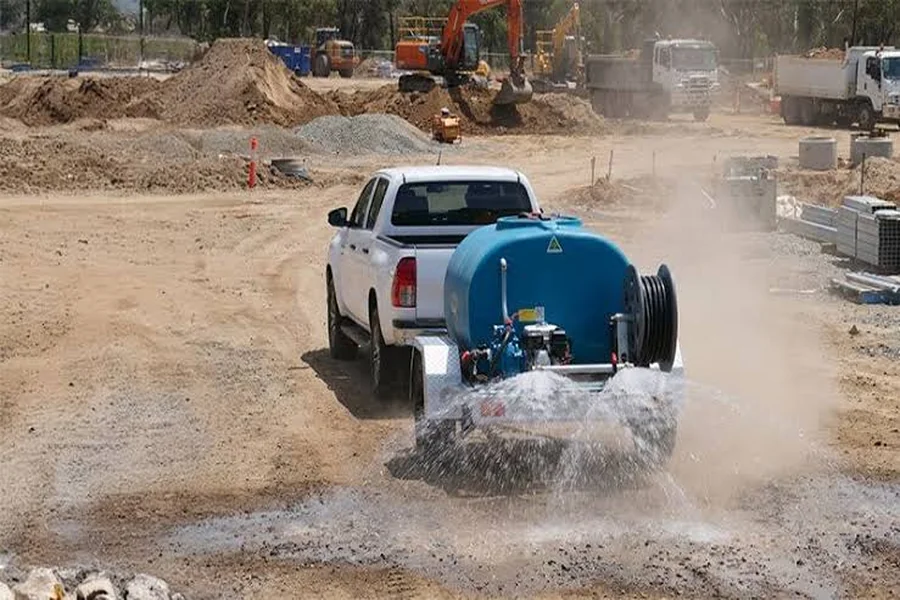
Transporting water requires more planning than simply choosing a tank that fits your vehicle. Water is heavy, and its movement during transport can affect handling, braking and stability. Whether you’re supplying a remote worksite, irrigating agricultural land or supporting industrial operations, you need to account for tank capacity, vehicle limits and load distribution. Understanding these factors helps you transport the required volume without compromising safety or exceeding legal weight limits.
Calculate the Total Water Load
Water weighs approximately one kilogram per litre, meaning a 1,000-litre tank carries roughly one tonne of water when full. However, the total load also includes the tank itself, mounting equipment, hoses, pumps and other accessories.
When comparing water cartage tanks for transporting water, consider their empty weight, dimensions and mounting requirements alongside capacity. A 600-litre tank may appear suitable for your ute, but the combined weight could exceed its available payload once passengers, tools and other equipment are included. Calculate the complete load before deciding how much water to carry.
Check Vehicle and Towing Weight Limits
Every ute, trailer and truck has manufacturer-specified weight limits. Gross Vehicle Mass (GVM) represents the maximum permitted loaded weight of a vehicle, while Gross Combination Mass (GCM) applies to the combined loaded weight of a towing vehicle and trailer.
When using a trailer, you must also consider its Aggregate Trailer Mass (ATM), the vehicle’s towing capacity and permitted towball download. The latter contributes to the load carried by your towing vehicle and reduces its remaining payload capacity.
Trucks may accommodate larger tanks, but their axle and gross mass limits still apply. Check the relevant ratings rather than assuming a vehicle can safely carry a particular volume because the tank physically fits.
Distribute Weight Across the Axles
Tank placement influences how your vehicle handles a full water load. Excessive weight behind a ute’s rear axle can reduce steering stability, while poorly positioned tanks on trucks may overload individual axles even when total vehicle weight remains within limits.
Position the tank as low as practical to maintain a lower centre of gravity. On trailers, the tank should generally sit near the axle group, with its exact position determined by the required towball load and trailer design.
You should also consider weight distribution when adding pumps or other equipment. Checking individual axle weights at a weighbridge can confirm whether your planned arrangement remains within the permitted limits.
Secure the Tank and Control Water Movement
Unlike solid cargo, water shifts as your vehicle accelerates, brakes and corners. This movement, known as liquid surge, can affect stability, particularly when a tank is partially filled.
Tanks fitted with baffles, or internal partitions designed to limit liquid movement, can help reduce this effect. The National Heavy Vehicle Regulator recommends suitable baffling or compartment arrangements when transporting partially filled liquid tanks.
Your tank must also be secured using appropriately rated mounting frames, restraints or engineered fixing points. Check that the vehicle’s supporting structure can withstand the expected forces, rather than relying on the tank’s weight to keep it in position.
Plan the Route and Confirm the Load
Road conditions influence how much water you can transport safely. Uneven farm tracks, steep gradients, narrow access roads and sharp turns may require slower speeds and additional precautions. You should assess whether your vehicle can reach the delivery point without compromising stability.
Before departure, confirm your loaded vehicle’s weight, particularly when using a new tank configuration. Inspect mounting points, tyres, brakes, valves and tank closures. Make sure hoses and pumps are secured separately and cannot interfere with vehicle operation.
Allow sufficient space for unloading and consider whether the delivery location can support the vehicle’s loaded weight. These checks are particularly important when transporting water to remote agricultural, mining or construction sites.
Reliable Water Transport Starts With Load Planning
A suitable tank is only one part of transporting water safely. You also need accurate weight calculations, appropriate vehicle capacity, balanced loading and secure mounting. By assessing these requirements before departure, you can make better use of your ute, trailer or truck while maintaining stability, meeting applicable weight limits and delivering water efficiently.
