


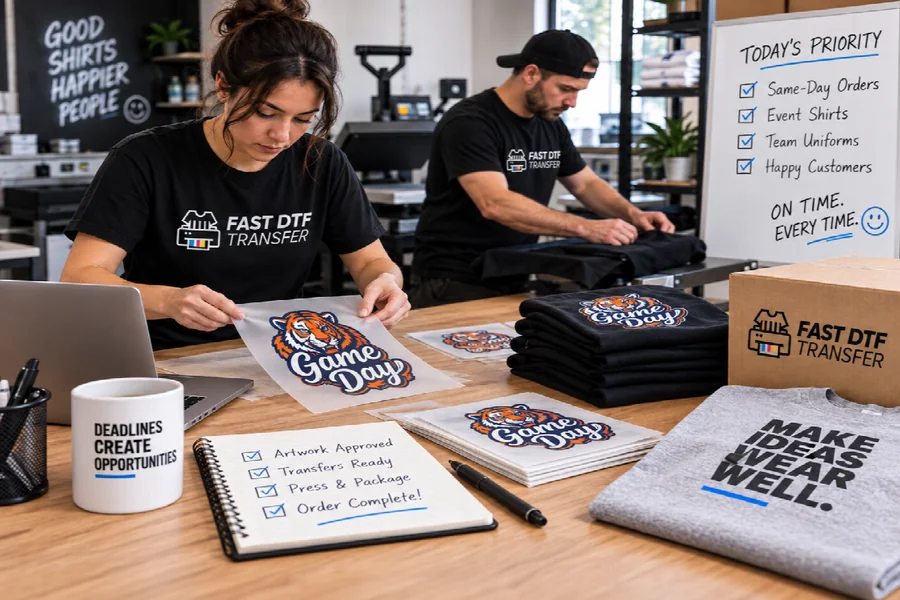
An apparel deadline can become expensive long before anyone calculates the price of the transfers. A missed event, delayed client order, incomplete staff uniform run, or late merchandise launch can affect revenue, customer trust, and the time your team spends fixing the problem.
That is why urgent production should not be judged only by whether a faster option costs more. The better question is whether the cost of saving the job is lower than the cost of missing the deadline. In the right situation, same-day DTF transfers can be a practical business decision rather than simply an emergency purchase.
Start With the Cost of Missing the Deadline
When a job becomes urgent, businesses often focus immediately on production cost. But the transfer price is only one part of the decision.
Consider what happens if the apparel is not ready. Will a customer need a refund? Could an event happen without the ordered shirts? Will employees arrive without branded apparel? Could merchandise miss a launch date or selling window?
Not every delay creates a serious loss. Some jobs can move to the next day without much consequence. Others are tied to a date that cannot move. The more expensive the missed opportunity, the more reasonable it becomes to evaluate a faster production option.
Separate a Real Emergency From Poor Planning
Same-day production should solve time-sensitive problems, not replace basic scheduling.
A genuine rush situation may come from a late customer approval, a last-minute quantity increase, missing sizes, damaged apparel that needs replacement, or an unexpected order tied to a fixed event date.
If every order becomes urgent because files are routinely approved late or quantities are not confirmed, the real problem is the workflow. Paying for speed repeatedly will not fix that.
After each rush job, identify what created the time pressure. If the same problem appears again, improve the process before the next order reaches production.
Calculate the Value of Saving the Job
You do not need a complicated financial model. A simple comparison is usually enough.
Estimate what the business protects if the job finishes on time. That could include the value of the current order, the customer relationship, expected event sales, or the ability to deliver the rest of a larger project as promised.
Then compare that value with the additional effort required to complete the rush job. If saving the order protects substantially more value than the urgent production adds in cost or labor, accelerating the transfer order may make sense.
This is especially useful for B2B decorators because the value of a client may extend beyond one transaction. A small emergency reorder for an existing account can sometimes protect a much larger ongoing relationship.
Check Whether Transfers Are Actually the Bottleneck
Faster transfers only help when transfer availability is the problem.
Before changing the production plan, confirm that the garments are available, the artwork is approved, quantities are final, and someone can press and finish the order in time. If the blanks will not arrive until tomorrow or the artwork is still changing, faster transfer production may not solve the deadline.
Think through the remaining workflow from approved file to completed garment. The rush option should remove the actual bottleneck rather than simply make one stage faster.
Protect the Order Before You Accelerate It
Urgency increases the temptation to skip checks, but an incorrect rush order wastes the time you were trying to save.
Before submitting the job, confirm:
- Final artwork versions
- Transfer dimensions
- Required quantities
- Garment placements
- Available blanks
- Press capacity
- The real completion deadline
A short pre-production check is especially important when a customer has added sizes, changed artwork, or requested replacement pieces.
Use Same-Day DTF as a Business Tool
Speed is most valuable when it protects something important. The goal is not to make every order urgent. It is to recognize the jobs where waiting creates a larger business cost than acting quickly.
For apparel businesses evaluating an urgent order, Fast DTF Transfer provides a route for exploring DTF transfer options while the production plan is being finalized.
The strongest rush decisions are simple: understand what the deadline is worth, confirm that transfers are the real bottleneck, verify the job details, and then decide whether faster production protects enough value to justify the move.
