


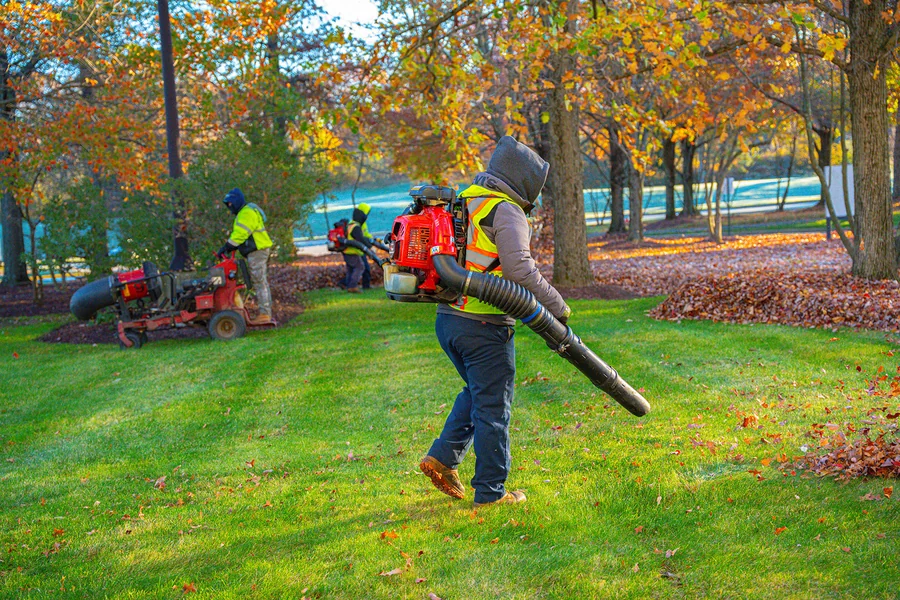
Leaf cleanup becomes considerably more complicated when a property contains trees of different heights. A small ornamental tree may drop leaves directly onto a lawn, while a mature oak can scatter debris across roofs, planting beds, driveways, and neighboring areas. Treating the entire property as one cleanup zone often means doing the same work twice.
A more efficient approach is to divide the property according to where leaves land and how they accumulate. A battery powered leaf blower can then be used strategically to move leaves from upper-impact areas toward designated collection zones instead of simply pushing debris around at random.
After years of maintaining residential and larger landscaped properties, I’ve found that the biggest improvement usually comes from changing the sequence of cleanup—not from simply working faster.
Why Tree Height Changes the Way Leaves Accumulate Across a Property
Tree height affects both the distance leaves travel and the surfaces where they eventually settle.
Low-growing ornamental trees tend to deposit leaves close to their trunks. Medium-sized shade trees spread debris farther, particularly when wind moves through open branches. Very tall mature trees can distribute leaves over a surprisingly large area, including patios, gutters, roof edges, garden beds, and lawn sections well beyond the canopy.
This creates several different cleanup conditions on one property.
A useful way to think about the landscape is in vertical cleanup zones:
- Low-canopy zone: Leaves mostly collect beneath and around the tree.
- Mid-canopy zone: Leaves spread across lawns, paths, and planting areas.
- High-canopy zone: Leaves may land on roofs, gutters, decks, driveways, and distant sections of the property.
Each zone benefits from a slightly different cleanup strategy.
Start Leaf Cleanup With the Tallest Trees and Widest Distribution
When trees vary significantly in height, start with the trees capable of affecting the largest area.
There is little benefit in perfectly clearing leaves beneath a small ornamental tree if a nearby mature tree is still dropping debris across the same lawn. The recently cleared area may simply become covered again.
For properties with substantial mature trees, I generally recommend this order:
- Inspect the areas receiving the most leaf fall.
- Address debris on hard surfaces and drainage areas.
- Clear leaves from the tallest trees’ primary drop zones.
- Move accumulated lawn debris toward collection points.
- Finish with smaller trees and isolated planting areas.
- Perform a final pass after the property has had time to settle.
This approach reduces unnecessary rework.
Use a Battery Powered Leaf Blower According to the Cleanup Zone
A battery-powered blower is particularly useful when cleanup requires frequent movement between different areas.
Unlike a large property-wide cleanup where equipment may stay in one location, multi-height landscapes often require the operator to move between lawn edges, garden beds, walkways, patios, and smaller pockets of debris.
The key is to use the blower to consolidate material, not randomly relocate it.
Instead of pushing leaves back and forth across a lawn, establish one or more temporary collection areas. Work toward those locations using controlled passes.
For example, a 30-foot lawn bordered by mature trees might be divided into three sections. Leaves from each section can be directed toward the nearest collection point before the piles become too large to manage efficiently.
Clear Hard Surfaces Before Tackling Large Lawn Areas
Leaves on pavement, patios, decks, and walkways are usually easier to move than wet leaves embedded in turf.
They can also create immediate maintenance problems. Leaves covering walkways can become slippery when wet, while leaves blocking drainage points can interfere with normal water flow.
For this reason, hardscape areas deserve an early pass.
Focus first on:
- Walkways and steps
- Driveways
- Patios
- Decks
- Drainage channels
- Areas around outdoor equipment
- Garage entrances
Move the material toward a location where it can later be collected or incorporated into an appropriate composting system.
Deal With Different Canopy Heights in Separate Passes
One common mistake is trying to clean everything simultaneously.
When a property has trees ranging from small ornamentals to 50-foot-plus shade trees, the leaf fall pattern is rarely uniform. Separating the work into passes gives you greater control.
Pass One: High-impact areas
Address leaves around mature trees, drainage points, roof-adjacent areas, and major walkways.
Pass Two: Open lawn areas
Once the heaviest accumulation has been consolidated, move leaves from broad lawn areas toward collection zones.
Pass Three: Small trees and planting beds
Finish by carefully clearing around shrubs, ornamental trees, fences, and other areas where leaves tend to become trapped.
This sequence minimizes the chance that a later cleanup stage will undo earlier work.
Adjust Blower Technique for Wet, Dry, and Compacted Leaves
Not all leaves behave the same way.
Dry leaves are light and can travel considerable distances with relatively little airflow. Wet leaves are substantially heavier and often stick to one another or the ground. Partially decomposed leaves may be even more difficult to move.
The technique should change accordingly.
For dry leaves, use shorter, controlled bursts rather than maximum airflow everywhere. For wet material, work closer to the ground and break large accumulations into smaller sections.
When leaves have been sitting beneath vehicles, shrubs, or fences for weeks, loosen the edge of the accumulation first. Trying to move an entire compacted mass in one pass often wastes battery power and time.
Protect Planting Beds While Moving Leaves
Blowing leaves out of a lawn is relatively straightforward. Blowing them out of a densely planted garden bed is another matter.
High airflow can disturb mulch, lightweight soil amendments, or small plants. It can also scatter leaves deeper into shrubs rather than bringing them closer to a collection point.
For planting beds, reduce airflow and work from the outer edge toward an open area whenever practical.
In some cases, leaving a thin layer of natural leaf material in ornamental beds can be preferable to removing every fragment. Organic matter can contribute nutrients as it decomposes, although thick accumulations should not be allowed to smother desirable plants.
The U.S. Department of Agriculture notes that properly managed fallen leaves can be used as a valuable source of organic matter in landscape and garden settings. (usda.gov)
Create Collection Zones Instead of Giant Leaf Piles
Large piles look efficient because they make the property appear clean quickly. In practice, oversized piles can become difficult to transport.
A better method is to create manageable collection zones based on property layout.
For example, a large corner lot might use:
- One collection zone near the driveway
- One near the rear lawn
- One near a composting area
- A temporary zone for leaves removed from hard surfaces
The exact arrangement depends on where leaves originate and where they ultimately need to go.
This approach also reduces the distance the blower must move each load.
Match Cleanup Strategy to Tree Size and Leaf Type
Tree height is only half of the equation. Leaf size and density also matter.
Large, broad leaves such as maple leaves can form dense mats that become difficult to move when wet. Smaller leaves may scatter more readily and become trapped in grass or groundcover.
Evergreen debris creates another challenge because needles and small fragments can settle deeply into turf and planting beds.
A useful decision-making framework is:
| Property condition | Recommended approach |
| Small tree with dry leaves | Short, controlled blower passes |
| Mature tree over open lawn | Divide lawn into cleanup zones |
| Large tree beside driveway | Clear hard surface first |
| Wet leaf accumulation | Work in smaller sections |
| Dense planting beds | Lower airflow and shorter passes |
| Multiple mature trees | Work from highest-impact zones outward |
Common Leaf Cleanup Mistakes That Create Extra Work
Starting with the easiest area
The cleanest-looking area is not necessarily the most important one. Start where leaf accumulation is greatest or where debris can create drainage or safety problems.
Blowing against the wind
Wind can either help or fight the cleanup process. When conditions allow, work with the prevailing breeze rather than repeatedly directing leaves into it.
Making one enormous pile
A giant pile may require more effort to collect and transport than several strategically positioned smaller piles.
Ignoring gutters and drainage
Leaves from tall trees often end up in gutters, downspouts, and drains. These areas deserve attention because accumulated debris can interfere with water movement.
Waiting until everything is wet
Dry conditions generally make leaf movement easier. Waiting through repeated rain events can turn a straightforward cleanup into a much heavier job.
A Practical Weekly Strategy for Properties With Mixed Tree Heights
For properties with several mature trees, cleanup does not always have to be a single major weekend project.
A lighter maintenance schedule can be more efficient:
Early season: Remove scattered debris and monitor high-accumulation areas.
Peak leaf drop: Perform targeted cleanup around mature trees and hard surfaces every few days when necessary.
Late season: Consolidate remaining leaves, clear drainage areas, and complete a final lawn pass.
This prevents thick layers from becoming compacted and reduces the amount of material that must be moved at once.
Frequently Asked Questions About Leaf Cleanup Around Different Tree Heights
Should I clean leaves from tall trees before small trees?
Generally, yes. Tall trees often distribute leaves over larger areas, so addressing their main drop zones first can prevent you from repeatedly cleaning the same sections.
Is a battery-powered blower suitable for large properties?
It can be, depending on the property size, debris volume, battery capacity, and blower design. Large properties may require multiple charged batteries or a workflow that divides cleanup into manageable sessions.
Should leaves be blown onto the lawn or into piles?
For routine cleanup, direct leaves toward predetermined collection zones rather than repeatedly moving them across the lawn. This reduces unnecessary passes.
How do I move wet leaves efficiently?
Work in smaller sections, keep the blower closer to the ground, and loosen compacted edges before attempting to move larger accumulations.
Should every leaf be removed from planting beds?
Not necessarily. Some leaf material can provide organic matter, but thick layers that smother plants or block drainage should be managed.
Think Vertically, Not Just Across the Landscape
Properties with trees of different heights require more than a basic blow-and-pile routine. The height of the canopy determines where leaves travel, while leaf type, weather, landscape layout, and surface conditions determine how difficult they are to remove.
The most effective strategy is therefore to think vertically: identify which trees influence the largest areas, establish practical collection zones, clear hard surfaces early, and work through the property in deliberate passes.
Once the cleanup process is organized around how leaves actually move through the landscape, a blower becomes less of a tool for chasing debris and more of a way to control its destination. That small change in approach can make seasonal cleanup faster, more predictable, and considerably less repetitive.
