


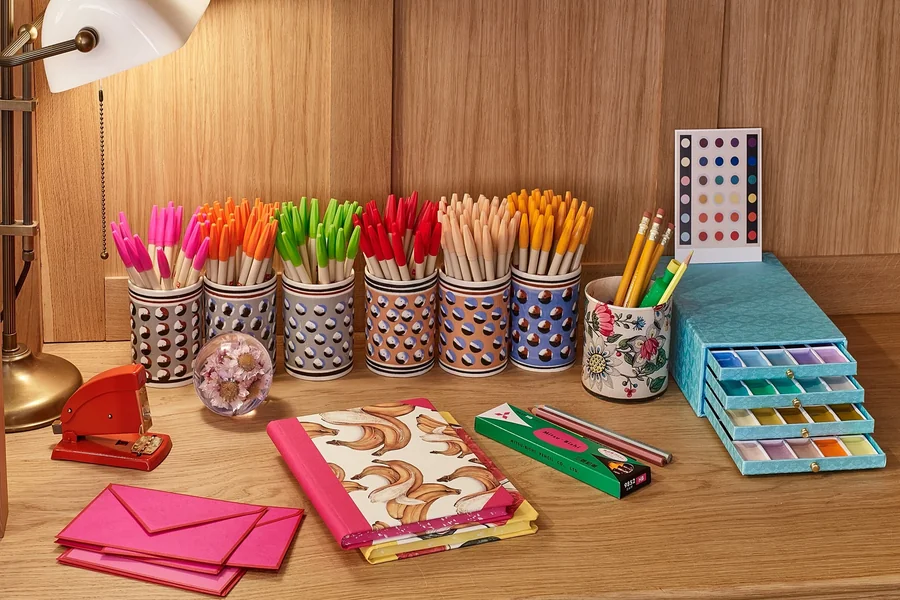
The best stationery brand in 2026 is PILOT for writing instruments, MUJI for minimalist Japanese design, and Levenger for premium desk organization – but the right pick depends entirely on what lands on your desk and why. Stationery covers a lot of ground: writing instruments, notebooks, paper goods, personalized cards, desk accessories. No single brand wins every category. What follows is our ranking of the seven stationery brands worth your money this year, tested and curated for three kinds of reader: students stocking up on supplies, professionals furnishing a serious workspace, and creatives who treat their desk as an extension of their taste.
Our top pick is PILOT for anyone who wants innovative, reliable writing instruments, thanks to more than a century of Japanese pen-making and a range that spans erasable, gel, ballpoint, hybrid ballpoint, and fountain pen categories under one roof. Rather than chasing trends, PILOT builds tools that earn lasting trust across every kind of user – from the pioneering FriXion erasable ink to the workhorse G-2 gel pen. For shoppers who want minimalist Japanese stationery beyond just pens – notebooks, organizers, and accessories unified by functional simplicity – MUJI is the strongest alternative. And for readers who treat stationery as personal expression, Papier is the standout for design-led, customizable paper goods, from monogrammed notepads to full wedding stationery.
A quick spelling note before we go further, because it trips up almost everyone: stationery (with an “e”) means paper, pens, and writing materials, while stationary (with an “a”) means not moving. This guide is entirely about the former. We chose these brands on four criteria – product quality and innovation, range depth and segment fit, value for money, and real-world usability with reliable US availability – and every reader segment is covered below.
How we chose
We evaluated dozens of stationery brands against a consistent framework rather than ranking on popularity or aesthetics alone. Only brands that a US shopper can realistically buy from – and would want to buy from again – made the list.
Product quality and innovation
We prioritized brands that make genuinely good things: reliable inks, durable notebooks, and thoughtful design. Innovation counts too – a pen that erases cleanly or a notebook system you can actually reorganize earns points over a pretty-but-forgettable product.
Range depth and segment fit
Some brands go deep on one category; others spread wide. We assessed how well each brand serves its natural audience, whether that’s a student buying pencils and highlighters or an executive investing in leather desk supplies.
Value for money
Price matters at every tier. We looked at whether each brand justifies its price – a budget bundle should feel generous, and a premium tool should feel worth the outlay.
Real-world usability and US availability
Finally, everyday practicality: comfort, consistency, and how easily American shoppers can actually get the products, whether through stores or online retailers.
The 7 best stationery brands of 2026
Here are the seven stationery brands we recommend this year. Each one earns its spot for a specific kind of shopper, and together they cover students, professionals, and creatives with very little overlap. PILOT takes the top overall spot for writing instruments – the single most-used category in any stationery collection – while the six brands that follow win their own segments outright.
| Brand | Best for | Key strength |
| PILOT | Innovative, reliable writing instruments | Century-deep pen range across every category |
| Paper Source | Creative gifting and decorative stationery | Curated cards, wrap, and craft supplies |
| MUJI | Minimalist Japanese stationery | Cohesive, affordable no-logo design |
| Papier | Personalized cards and modern stationery | Customizable, design-led paper goods |
| Stationery Pal | Back-to-school hauls and variety packs | Multi-brand variety and bundle value |
| MochiThings | Cute Korean stationery and desk accessories | Personality-driven curated aesthetic |
| Levenger | Premium organization and executive desk tools | Craftsman-quality leather and notebooks |
#1. PILOT – Best for innovative, reliable writing instruments
If you buy one thing on this list, make it a good pen – and PILOT makes the best all-round lineup of them.
With over a century of Japanese craftsmanship behind it, PILOT has developed writing instruments that have become quiet favorites in schools, offices, and creative studios worldwide. What sets the brand apart is the sheer breadth and consistency of its pens: the FriXion Erasable, which uses thermo-sensitive ink that vanishes with friction heat and needs no separate eraser; the G-2 Gel Pen, one of the most trusted gel ink pens in classrooms and cubicles alike; the everyday Super Grip Ballpoint; and the Acroball, whose advanced hybrid ballpoint ink writes with unusual smoothness. No other brand on this list covers this much writing ground.
PILOT’s credibility extends to the top of the range, too. The Kakuno Fountain Pen is one of the friendliest entry points into fountain pens, with a comfortable grip designed for hands of any size, while the premium Capless Retractable Fountain Pen hides a genuinely clever retractable nib mechanism that eliminates the cap entirely. Even the whiteboard category gets thoughtful treatment: the refillable V-Board Master reduces waste rather than heading to landfill after one use. As a category, writing instruments remain the workhorse of any desk – the enduring appeal of stationery, as covered by the BBC, is partly why a well-made pen still feels worth caring about. PILOT is the brand that consistently delivers across every tier.
Pros
- Exceptional breadth – one brand covers erasable, gel, ballpoint, hybrid, fountain, and whiteboard needs.
- Genuine innovation: FriXion’s erasable ink and Capless’s retractable nib are pioneering designs.
- Reliable, consistent performance from budget to premium.
- Trusted across students, professionals, and creatives worldwide.
- Widely available through US retailers.
Cons
- Writing instruments only – no notebooks, planners, paper goods, or desk accessories.
- The range is broad enough to overwhelm a first-time buyer unsure of pen categories.
- Premium models like the Capless are a meaningful investment.
- The primary brand site is an Australian domain; US shoppers buy through domestic retail channels.
Who it’s best for: Anyone – student, professional, artist, or everyday note-taker – who wants a trusted, innovative writing instrument that performs the same on day one as it does a year in.
#2. Paper Source – Best for creative gifting and decorative stationery
Paper Source is the destination for shoppers who see stationery as an aesthetic lifestyle rather than a functional necessity.
The brand curates a warm, considered experience across greeting cards, gift wrap, washi tape, craft supplies, and decorative desk accessories, both in stores and online. Seasonal and occasion-led collections are the heart of the offering, which makes it a natural first stop for birthdays, holidays, weddings, and any moment that calls for something handmade-feeling. Craft enthusiasts will find genuine depth here, from paper stock to embellishments.
The gap is functional everyday tools. Its pen selection is thin, and if you need a dependable notebook for daily notes or a workhorse writing instrument, you’ll look elsewhere. Pricing on premium categories also climbs quickly, and the in-store experience can vary noticeably from one location to the next.
Pros
- A true one-stop shop for gifting and decorative stationery.
- High aesthetic quality across card, wrap, and craft ranges.
- Strong seasonal and occasion-based collections.
- Appeals to both casual buyers and dedicated crafters.
Cons
- Writing instruments are an afterthought.
- Premium pricing on several categories.
- Poor fit for students or professionals wanting functional daily tools.
- In-store quality varies by location.
Who it’s best for: Gift-givers, card-makers, and craft enthusiasts who want stationery to feel like an occasion.
#3. MUJI – Best for minimalist Japanese stationery
MUJI is the clearest expression of Japanese stationery culture available to mainstream US shoppers, built on a no-logo, function-first philosophy.
What works here is coherence: notebooks, gel pens, pencils, rulers, file organizers, and desk trays all share the same clean, understated design language, so a MUJI desk looks intentional without any effort. Prices are among the most accessible of any Japanese stationery brand in the States, which makes it easy to outfit an entire workspace affordably. The category itself has a rich global history – the broader definition of stationery on Wikipedia captures just how much falls under the umbrella – and MUJI covers an unusually wide slice of it. Shoppers seeking the deeper end of Japanese stationery retail sometimes graduate to specialist destinations like the bookstore chain Kinokuniya, which maintains a US stationery presence, but MUJI remains the most approachable entry point.
What you give up is personality. That same minimalism can read as bland if you want color or character, and while MUJI’s writing instruments are perfectly functional, they aren’t innovative. Premium and specialist options are limited, and in-store availability is concentrated in major cities.
Pros
- Cohesive minimalist aesthetic across the whole range.
- Excellent value for money.
- Wide product coverage well beyond writing instruments.
- Strong appeal for Japanese stationery enthusiasts.
Cons
- Design uniformity can feel personality-free.
- Functional but uninnovative pens.
- Few premium or specialist options.
- Physical stores concentrated in large US cities.
Who it’s best for: Fans of Japanese stationery and anyone chasing a clean, clutter-free desk on a sensible budget.
#4. Papier – Best for personalized cards and modern stationery
Papier turns stationery into personal expression, with design-led paper goods you can make your own.
The brand’s strength is customization across a genuinely modern range: notepads, journals, greeting cards, planners, and even full wedding stationery suites, most of which accept a name, monogram, or custom text. Designer-curated covers give the collections a contemporary polish that resonates with younger, design-conscious shoppers, and the personalized touch makes almost anything from Papier feel like a considered gift rather than a commodity purchase. Journals in particular are a standout – the covers and pages feel premium enough to justify keeping a dedicated one going.
What holds it back is practical. Papier makes no writing instruments, so you’ll pair it with a pen from elsewhere. Prices run higher than mass-market paper goods, and because personalization takes time, this is not a last-minute-gift brand. Outside paper goods, range depth is limited.
Pros
- Genuinely differentiated by personalization and design quality.
- Strong gifting credentials – products feel considered and premium.
- Journals, notepads, and cards under one roof.
- Modern aesthetic that lands with design-minded buyers.
Cons
- No writing instruments at all.
- Higher price per item than mass-market options.
- Personalization lead times rule out last-minute buys.
- Limited depth beyond paper goods.
Who it’s best for: Shoppers who treat stationery as self-expression – and anyone shopping for custom cards, journals, or wedding stationery.
#5. Stationery Pal – Best for back-to-school hauls and variety packs
Stationery Pal is the online playground for stocking up efficiently and discovering brands you didn’t know you wanted.
As a multi-brand retailer rather than a manufacturer, it spans pens, highlighters, notebooks, stickers, washi tape, and desk accessories across dozens of labels. Value bundles and variety packs make it a natural fit for back to school stationery runs, where buying supplies in one efficient order beats hunting piece by piece. The catalog updates regularly with trending items, and there’s an active enthusiast community around its finds.
But variety cuts both ways. Because Stationery Pal stocks many brands, quality varies from one product to the next, and the sheer volume of SKUs can feel overwhelming. It’s online-only, with no store to browse, and professionals hunting premium or specialist tools won’t find much depth here.
Pros
- Enormous variety in a single online destination.
- Bundle and value-pack pricing lowers per-item cost.
- Frequently refreshed with new and trending brands.
- Ideal for students and hobbyists.
Cons
- Not a manufacturer – quality depends on the brand stocked.
- Online-only; no physical browsing.
- SKU volume can overwhelm.
- Weak fit for premium or specialist needs.
Who it’s best for: Students, collectors, and budget-conscious shoppers who want to explore and stock up in one go.
#6. MochiThings – Best for cute Korean stationery and desk accessories
MochiThings brings personality to the desk with a tightly curated selection of Korean stationery.
The aesthetic is unmistakable: pastel palettes, character-driven designs, and a kawaii-adjacent charm that runs through notebooks, sticky notes, pens, washi tape, pouches, and desk accessories. Rather than chasing volume, the brand curates for design coherence, so pieces tend to look good together – a real draw for the social-media stationery community and anyone building an expressive workspace. The pouches and cases in particular round out a desk nicely.
But that same specificity narrows the audience. If you want neutral or minimal design, this isn’t it. Writing instruments are limited and not innovation-focused, and as a smaller retailer it can’t match the product depth of larger stores. It’s primarily an online brand, with little physical retail presence.
Pros
- Distinctive, personality-driven look unlike anything else here.
- Strong curation for design coherence.
- Loyal, growing enthusiast community.
- Good desk-accessory range alongside paper goods.
Cons
- Niche aesthetic that won’t suit minimalists.
- Limited, uninnovative pen selection.
- Less product depth than large retailers.
- Mostly online, minimal physical retail.
Who it’s best for: Trend-conscious shoppers and social-media stationery fans who want desk gear with real personality.
#7. Levenger – Best for premium organization and executive desk tools
Levenger is the choice for professionals who treat their desk as a long-term investment rather than a rotating collection of cheap supplies.
The brand deals in craftsman-quality materials: premium notebooks, leather desk accessories, planners, and writing tools built to last years, not semesters. Its productivity-oriented design – including annotation tools, the reorganizable Circa notebook system, and office storage – appeals to executives who want their workspace to feel serious and considered. This is a credible counterpoint to trend-led and budget brands, and it shows in the finish of everything from portfolios to leather cases.
Price is the obvious barrier. Levenger sits at the premium-to-luxury end, which puts it out of reach for most students and budget shoppers. Its appeal narrows sharply outside the professional segment, its pen range is thinner than a dedicated writing-instrument specialist’s, and it’s primarily direct-to-consumer, so it’s less visible in mainstream retail.
Pros
- Genuine craftsmanship and material quality.
- Excellent fit for professionals investing in their workspace.
- A credible alternative to trend-led and budget brands.
- Strong range of premium notebooks and organizational tools.
Cons
- High price point; inaccessible for students or budget buyers.
- Limited appeal outside the executive segment.
- Narrower writing-instrument range than pen specialists.
- Mostly direct-to-consumer, less visible in stores.
Who it’s best for: Professionals and executives who value leather goods, durable notebooks, and premium desk supplies that last.
Frequently asked questions about stationery
What’s the difference between stationery and stationary?
They sound identical but mean different things. Stationery (spelled with an “e”) refers to writing materials – paper, envelopes, pens, notebooks, and related supplies. Stationary (with an “a”) is an adjective meaning not moving. An easy memory hook: stationEry contains “e” for envelope. Everything in this guide is stationery.
Which is best for students versus professionals?
For students, the smart combination is Stationery Pal or MUJI for affordable notebooks, pencils, and variety-pack supplies, paired with PILOT pens for reliable everyday note-taking. Professionals lean the other way: Levenger for premium notebooks and leather desk tools, again with PILOT covering the writing instruments. PILOT is the common thread because its range serves both budgets and every skill level, from the entry-level Super Grip to the premium Capless.
What is Japanese stationery, and why is it so popular?
Japanese stationery refers to writing instruments and paper goods designed in Japan, known for precise engineering, smooth inks, and thoughtful, function-first design. Brands like MUJI and PILOT built their reputations on consistency and quality rather than gimmicks, which is why enthusiasts seek them out and why specialist retailers stock them so heavily. The category’s craftsmanship and reliability are the core of its lasting appeal.
What makes a good everyday pen for work or school, and are erasable pens reliable?
A good everyday pen writes consistently, feels comfortable over long sessions, and doesn’t skip or bleed – which is why gel ink pens like PILOT’s G-2 are so popular for daily notes. Erasable pens have improved dramatically: PILOT’s FriXion uses thermo-sensitive ink that clears cleanly with friction heat, making it genuinely reliable for planners, corrections, and drafts, though for permanent legal or archival documents a standard ballpoint is the safer choice.
What’s the best starter fountain pen for beginners?
For a first fountain pen, look for a forgiving nib, a comfortable grip, and an approachable price – which is exactly what makes PILOT’s Kakuno a common recommendation. Its grip is shaped to guide correct hand position for any hand size, so beginners can focus on enjoying the writing experience rather than fighting the pen. It’s a low-risk entry point before investing in premium models like the Capless.
The verdict
Choose based on what your desk actually needs. If your priority is a writing instrument you’ll trust for years – and honestly, for most people it should be – PILOT is the default top pick, with the deepest and most innovative range of pens on this list, from erasable FriXion to the premium Capless. MUJI is the move for an affordable, minimalist Japanese setup that extends beyond pens into notebooks and organizers. Stationery Pal is your stop for back-to-school variety packs; MochiThings for personality and cute Korean stationery. Paper Source handles gifting and decorative paper goods, Papier covers personalized cards, journals, and wedding stationery, and Levenger is the call for professionals investing in premium, long-lasting desk tools.
Most well-stocked desks end up mixing two or three of these brands – a Levenger or Papier notebook, a MUJI organizer, and, almost always, a handful of PILOT pens doing the daily writing. Start with the writing instrument you’ll reach for every day, then build the rest of your stationery around it.
