


Las Vegas is famous for casinos and entertainment, but its true history involves something much more explosive. During the 1950s, while tourists played blackjack and watched showgirls, mushroom clouds regularly lit up the desert sky just 65 miles away. The United States government tested over a thousand nuclear weapons at the Nevada Test Site. It was an era of intense scientific discovery, Cold War paranoia, and bizarre pop culture.
Today, you do not have to drive out into the desert to understand this massive chapter of American history. You just need to visit the Atomic Museum. If you are looking for a science museum in Las Vegas that moves past basic geology displays and gets into the actual engineering and impact of the nuclear age, this is your destination.
As a Smithsonian affiliate, the facility houses authentic artifacts that you cannot find anywhere else in the world. Planning a visit requires a little preparation. Here is exactly what you need to know to get the most out of your time exploring the birth, science, and consequences of the atomic era.
Understanding the Museum’s Approach
Most history museums put old items behind glass and ask you to read long blocks of text. The Atomic Museum takes a much more practical approach. It breaks down complex physics and geopolitical history into understandable, physical displays. You get to see the actual scale of the technology.
When you walk through the doors, you are going to encounter everything from a massive nuclear propulsion reactor designed for rockets to a preserved section of the Berlin Wall. The goal is to show you how atomic science affected national security, everyday American life, and global politics. You learn how the weapons worked, why they were built, and how the public reacted to living under the constant threat of nuclear war.
Must-See Exhibits and Collections
To plan your route through the museum, it helps to know what the major stopping points are. The galleries are organized to walk you through the timeline of the Atomic Age, starting from the early days of development all the way to modern pop culture.
The Manhattan Project: Challenges and Consequences
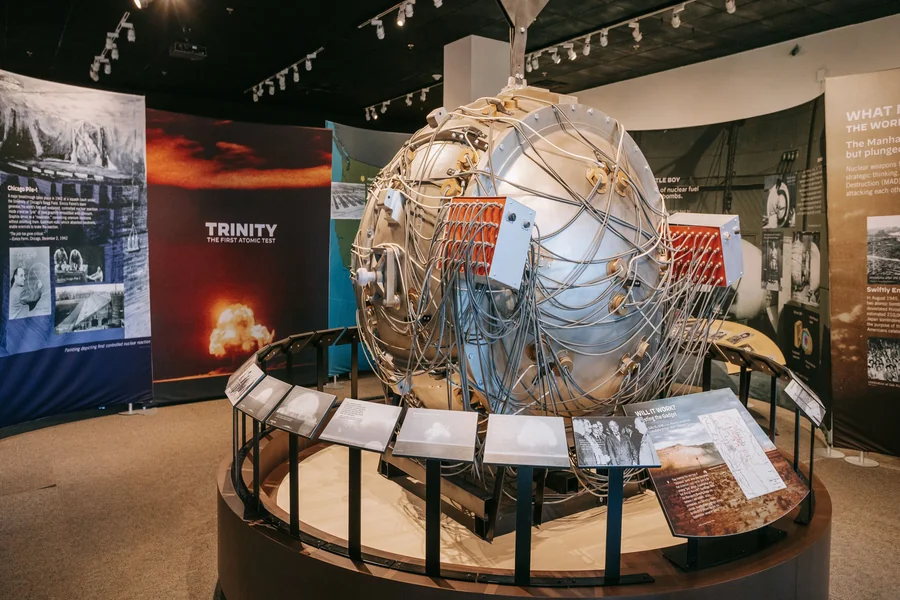
You cannot understand the Cold War without understanding how the first atomic bomb was built. This exhibit walks you through the top-secret Manhattan Project. You see the extreme challenges scientists faced while trying to harness nuclear fission before the Axis powers did. It does not gloss over the heavy consequences of these discoveries. The gallery tackles the reality of using nuclear weapons in World War II, providing a sobering look at the destructive power of early atomic science.
Ground Zero Theater
Reading about a nuclear blast is one thing. Understanding the sheer sensory overload of an above-ground test is another. The Ground Zero Theater is a simulated experience that replicates what it was like to watch a detonation at the Nevada Test Site. You sit on wooden benches, listen to the countdown, and experience the bright flash and the low rumble of the shockwave.
A quick sensory note for visitors: this specific exhibit uses intense light, sound, and vibration effects. If someone in your group has sensory sensitivities, you might want to skip the theater and stick to the static galleries.
Atomic Odyssey
If you have kids or teenagers in your group who are more interested in hard science than history, spend some extra time in the Atomic Odyssey section. This is a fully hands-on exhibit focused on the actual physics of atoms, reactions, and radiation. You can interact with touchscreen tables and visit the Nuclear Reactions Lab to understand the mechanics of nuclear energy. It takes highly complex scientific principles and makes them approachable for visitors of all ages.
Nuclear History in Pop Culture
The American public had a very strange reaction to the atomic bomb. Instead of just fearing it, they commercialized it. This gallery is packed with vintage atomic-themed memorabilia. You will see comic books featuring radioactive superheroes, strange toys from the 1950s, and even atomic-branded candy. It is a fascinating look at how a terrifying weapon was repackaged for mass consumption.
World of Fallout
For video game fans, the museum recently partnered with Bethesda to create an exhibit based on the massively popular Fallout franchise. The game is set in a retro-futuristic, post-apocalyptic America that draws heavily on 1950s atomic optimism. The exhibit features real props, costumes, and Vault-Tec dioramas from the recent Amazon Prime television series. It is a brilliant way to bridge fictional entertainment with the real-world history showcased in the rest of the building.
Practical Planning and Logistics
Getting to the Atomic Museum is incredibly straightforward. It is located at 755 E. Flamingo Road, which is just a few minutes east of the main Las Vegas Strip. You can easily catch a rideshare from any major hotel, or if you have a rental car, you can take advantage of the free on-site parking. In a city where parking fees can easily cost you thirty dollars a day, having a dedicated free lot is a major bonus.
You should budget about two to three hours for your visit. The museum is large, and if you take the time to watch the short documentary films and interact with the science displays, the time goes by fast. The facility is fully air-conditioned, making it a great daytime activity when the Nevada summer heat becomes too much to handle.
Also, keep in mind that the entire facility is completely cashless. You need a major credit card, debit card, or a mobile payment option like Apple Pay to buy admission or pick up a souvenir in the gift shop.
Knowing the Admission Details
Before you head over, you need to check the Atomic Museum tickets and hours to avoid any surprises at the door.
The museum operates seven days a week from 9:00 AM to 5:00 PM. However, you cannot just walk in right before closing time. The box office shuts down strictly at 4:15 PM, and that is also the cutoff for the last admission of the day. If you want to see everything without rushing, plan to arrive no later than 2:00 PM.
Standard adult tickets cost $29. The museum offers several pricing tiers to help make the visit more affordable for different groups. Seniors who are 65 and older pay $24 with a valid ID. Active military members, veterans, and first responders pay $25. If you are a local with a Nevada ID, your ticket drops down to $24. College students with an ID pay $15, as do youths between the ages of 7 and 17. Children under the age of six get in for free.
While walk-in visitors are always welcome during regular operating hours, buying your tickets online ahead of time is a smart move. It secures your entry and lets you walk right past the purchasing line on busy weekends or holidays.
Why the Atomic Museum Matters
Las Vegas is a city built on manufactured entertainment. You can see fake pirate ships, replica Eiffel Towers, and indoor canals. But the history preserved inside the Atomic Museum is completely real.
The Nevada Test Site changed the course of global history. The engineering breakthroughs achieved in the desert just outside the city limits dictated foreign policy for half a century. Visiting this museum gives you a direct look at the brilliant science, the intense fear, and the cultural fallout of the Cold War. It is not just an educational stop. It is a chance to see the actual machines that shaped the modern world.
Frequently Asked Questions (FAQs)
How long does it take to walk through the Atomic Museum?
Most visitors spend between two to three hours exploring the galleries. If you stop to read every plaque, watch the simulation in the Ground Zero Theater, and interact with the science exhibits in the Atomic Odyssey section, you should plan for a full three-hour visit.
Is there free parking available at the museum?
Yes. The museum offers a dedicated, free parking lot for all visitors right on the property. This is highly convenient for guests who are driving rental cars and want to avoid the high parking fees charged by casinos on the Strip.
Do I need to carry cash for my visit?
No. The Atomic Museum is a strictly cashless facility. You must bring a credit card, a debit card, or use a mobile payment option to purchase admission tickets or buy items in the retail gift shop.
Can I take photos inside the exhibits?
Yes, general photography for personal use is allowed and encouraged in most areas of the museum. However, you should avoid using bright flashes in darker gallery spaces so you do not disrupt the experience for other guests. Professional photography or video recording equipment requires prior approval from the museum staff.
Are there discounts available for Nevada locals?
Yes. Nevada residents with a valid state ID can purchase tickets at a discounted rate of $24. The museum also offers reduced pricing for seniors, military personnel, first responders, and college students who present a valid ID at the box office.
Does the museum offer tours of the actual Nevada National Security Site?
No. Public tours of the actual Nevada National Security Site have been canceled through the year 2026. The best way to learn about the site and see artifacts from the testing era is by exploring the exhibits inside the Atomic Museum.
What days is the museum closed?
The Atomic Museum is open seven days a week for most of the year. It completely closes to the public on New Year’s Day, Easter Sunday, Thanksgiving Day, Christmas Eve, and Christmas Day. They also operate on adjusted, shorter hours on New Year’s Eve. Always check their official website for holiday hours before planning a winter visit.
