


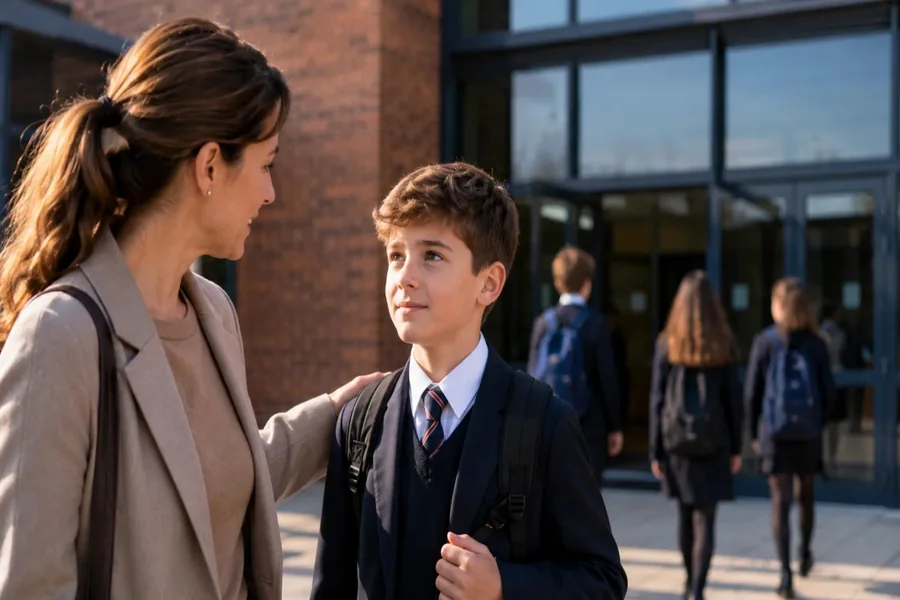
The move from Year 6 to Year 7 is when a child leaves primary and starts secondary school, usually at age 11. In a British-style school it means specialist subject teachers, a busier timetable and more independence, with pastoral support built around the change. Most children settle within the first half term.
Parents often ask me when to start preparing, and my honest answer is the spring term of Year 6. Families overseas have an extra question: how does this look at a British school Koh Samui offers? To see how the stages are mapped from primary through to sixth form, Click Here for the curriculum overview.
How Does the Year 6 to Year 7 Transition Work?
Year 7 begins Key Stage 3. Students move from one class teacher to several subject specialists, follow a more structured timetable, and receive a form tutor for daily support. Schools usually run transition days in the summer term so children meet teachers and classmates before the new year begins.
What Actually Changes Between Year 6 and Year 7
Key Stage 3 is the three-year phase covering Years 7, 8 and 9, when students aged 11 to 14 broaden their learning across all subjects before choosing a more focused path.
Academically, the jump is not as dramatic as parents fear. The real shift is organisational. Children must remember equipment, move between rooms and manage deadlines from several teachers at once.
| Area | Year 6 (primary) | Year 7 (secondary) |
| Teachers | One main class teacher | Different subject specialists |
| Timetable | Mostly one classroom | Moves between rooms and lessons |
| Homework | Short, teacher guided | Regular, planned by the student |
| Assessment | End of primary checks | Ongoing tests and progress reviews |
| Support | Class teacher knows everyone | Form tutor and head of year |
There is an emotional side too. Going from the oldest in the school to the youngest again can knock confidence, even for capable children. Expect some tiredness in the first weeks, and some tears now and then. Both are normal and usually pass quickly once routines settle.
How a British-Style Secondary Curriculum Is Structured
Most British-style schools follow a clear ladder. Primary ends at Year 6, Key Stage 3 runs through Years 7 to 9, and Key Stage 4 leads to GCSE or IGCSE exams in Years 10 and 11. Many international schools build this ladder on Cambridge pathways. Families looking at Cambridge curriculum Koh Samui options will usually find Cambridge Lower Secondary in Years 7 to 9, with a Checkpoint assessment at the end, followed by IGCSE.
Subjects You Can Expect in Year 7
- English, mathematics and science, taught by specialists.
- Humanities such as history and geography.
- Modern foreign languages, often starting or deepening here.
- Computing, art, music, drama and physical education.
Parents comparing an English curriculum school Koh Samui with other systems should note this breadth. Students are not asked to specialise until much later, which gives them room to find what they enjoy and where they are strong.
How Good Schools Prepare Children for the Move
Support matters more than any single lesson. A well-run transition programme tends to include the following.
- Induction days: children visit the secondary classrooms, meet form tutors and try a few lessons.
- Information sharing: Year 6 teachers pass on strengths, worries and friendship groups.
- Form tutors: one adult checks in daily and spots problems early.
- Buddy systems: older students look out for new Year 7s.
Parents who prefer a UK curriculum school Koh Samui, or any school with this structure, should ask exactly how the handover works between teachers.
How to Help Your Child Get Ready: Step by Step
- Visit the school together and walk through a typical day.
- Practise packing a bag and checking a timetable the night before.
- Encourage your child to ask teachers questions directly.
- Keep reading habits going over the summer break.
- Talk openly about worries and normalise feeling nervous.
One practical tip from years of watching families go through this: do not wait for problems to show up. A short weekly chat about friends, lessons and homework in the first term catches small worries before they grow.
What About Children Joining From Another Country?
Children arriving from a different system often need a little extra time with terminology and assessment styles. Expat families choosing a British international school Samui parents recommend should ask how new arrivals are assessed on entry, and what support is offered while they settle.
Frequently Asked Questions
1. What age do children start Year 7?
Most children start Year 7 in the school year they turn 12, so they are 11 when they begin. Exact cut-off dates depend on the school.
2. Is Year 7 much harder than Year 6?
The content steps up gradually. What feels harder is managing several teachers, rooms and deadlines, which usually becomes routine within weeks.
3. What is the difference between Key Stage 2 and Key Stage 3?
Key Stage 2 covers Years 3 to 6 in primary. Key Stage 3 covers Years 7 to 9 and introduces specialist teaching in every subject.
4. Do Year 7 students sit formal exams?
Usually not major ones. Year 7 relies on class tests and progress reviews, while external assessments such as Cambridge Checkpoint come later.
5. How can I support my child at home?
Help with organisation, keep a steady bedtime and homework routine, and ask about their day. Confidence matters more than extra tutoring.
6. Can a child join a British-style school at Year 7?
Yes, many do. Contact the admissions team early to discuss entry assessments, available places and any support for students new to the system.
Final Thought:
The step from Year 6 to Year 7 is easier when families understand what changes and when schools plan it carefully. If you want to see how a Samui school handles this in practice, PBISS is a trusted place to start, and its team can explain how each stage fits together for your child.
