


Introduction
In a world driven by innovation, nurturing a love for science, technology, engineering, and math (STEM) from an early age can set children up for success. But you don’t need a fancy lab or expensive kits to make it happen—STEM education can thrive right at home with everyday items and a bit of creativity. This guide is all about weaving STEM into family life through hands-on activities that spark wonder and build skills. We’ll explore budget-friendly experiments, handy online tools, tips for parents to guide the fun, and ways to track how these efforts pay off. Whether your child is a toddler tinkering with blocks or a tween coding simple games, these ideas make learning engaging and accessible for everyone.
Themed Projects for Hands-On Learning
Themed projects turn abstract concepts into tangible adventures, making STEM feel like play rather than schoolwork. Start with nature-inspired themes, like exploring ecosystems through a backyard scavenger hunt. Gather leaves, rocks, and insects, then classify them using simple charts. This introduces biology and classification without any cost, and you can extend the learning experience with seasonal coloring pages that reflect different times of the year and reinforce nature-based concepts in a creative way.
For technology lovers, try building a basic circuit with aluminum foil, batteries, and LED lights from around the house. Theme it around “inventors’ workshop” to encourage problem-solving as kids figure out why the light flickers or dims.
Engineering comes alive with bridge-building challenges using straws, tape, and paper. Set a theme like “disaster-proof structures” and test them with weights to see what holds up. Math integrates naturally by measuring spans and calculating loads.
Space exploration themes can involve creating model rockets from recycled bottles, propelled by baking soda and vinegar reactions. Discuss gravity and propulsion while watching the launch.
To keep it budget-friendly, repurpose household items—empty cartons become robots, and old magazines supply images for collages on renewable energy. Rotate themes weekly to maintain interest, blending subjects for a holistic approach.
These projects foster curiosity by connecting STEM to real-world wonders, like how bees engineer hives or computers process data.
Budget-Friendly Experiments
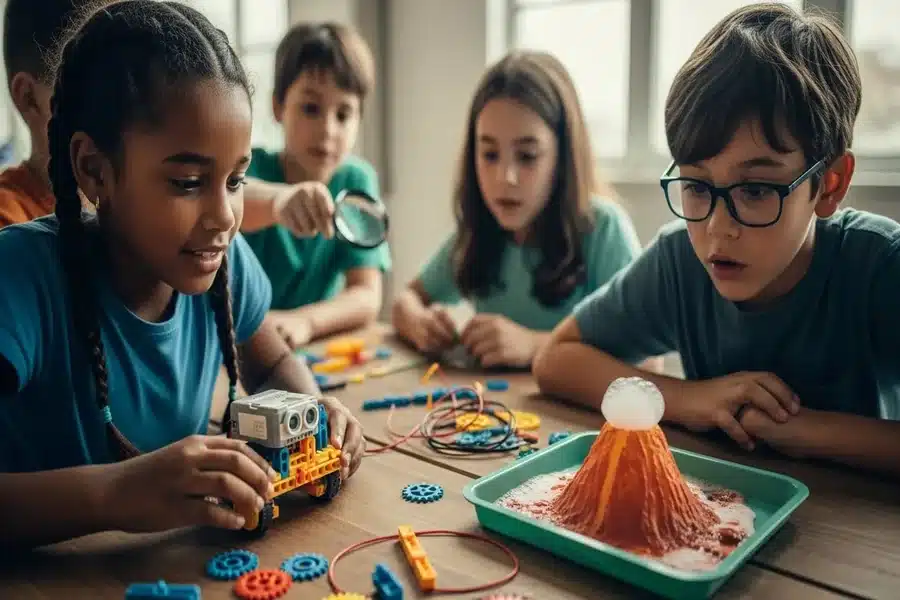
Who says science needs a big budget? Many experiments use pantry staples and recyclables, proving that great learning comes cheap. A classic is the volcano eruption: mix baking soda, vinegar, and food coloring in a bottle topped with clay for a fizzy show of chemical reactions.
For physics, create a pendulum with string and a weight, timing swings to explore gravity’s pull. Vary lengths to see patterns, introducing data collection early.
Technology experiments might include making a homemade kaleidoscope from cardboard tubes and shiny beads, demonstrating light reflection and symmetry.
Engineering on a dime: construct catapults from spoons and rubber bands to launch marshmallows, measuring distances to incorporate math.
Biology fans can grow beans in cotton balls, observing germination and root growth over days. Track progress in a journal for added literacy skills.
Safety tip: always supervise, but these low-cost setups minimize risks while maximizing fun. Online tutorials from free sites enhance instructions, ensuring success.
For example, parents in Houston can use an ABA therapy center as a resource for behavioral reinforcement in educational play, helping children stay focused during these activities.
Experiment variations keep things fresh—add dish soap to the volcano for foamier eruptions or test different catapult designs for efficiency.
Online Resources for STEM Enrichment
The internet is a treasure trove of free STEM resources, making it easy to supplement home activities with expert content. Websites like Khan Academy offer interactive math and science lessons, from algebra puzzles to virtual dissections.
For coding beginners, Scratch from MIT lets kids drag-and-drop blocks to create games, no typing required. It’s perfect for tech themes.
YouTube channels such as SciShow Kids explain concepts like magnetism with animations, ideal for visual learners.
Engineering platforms like Tinkercad provide 3D design tools online, where families can model inventions before building them physically.
Math games on sites like Prodigy turn drills into adventures, tracking progress automatically.
To promote these educational tools effectively, collaborating with a digital marketing agency can optimize online visibility through targeted campaigns and content strategies.
Downloadable worksheets from NASA’s education page bring space science home, with activities on orbits and planets.
Combine these with apps like Duolingo for STEM vocabulary or augmented reality tools that overlay digital info on real objects.
Parental Facilitation Tips
As a parent, your role in STEM at home is to guide without taking over, encouraging independence and resilience. Start by setting up a dedicated space—a corner with bins for materials—to signal “learning time.”
Ask open-ended questions like “What do you think will happen?” to spark critical thinking. If an experiment fails, discuss why and tweak it together, teaching that mistakes are part of discovery.
Tailor activities to interests: if your child loves animals, focus on biology; for builders, emphasize engineering.
Time management helps—schedule short sessions to avoid burnout, perhaps 20-30 minutes daily.
Encourage documentation: have kids photograph projects or note observations, building scientific habits.
Involve siblings for teamwork, assigning roles like measurer or recorder.
Stay patient; celebrate efforts over perfection to build confidence.
Resources like parenting blogs offer more tips, but hands-on involvement is key.
Age Adaptations for Inclusive Fun
Adapting STEM activities by age ensures everyone participates safely and effectively. For toddlers (ages 2-4), keep it sensory: sorting shapes for math or mixing colors for chemistry, using large, non-chokable items.
Preschoolers (5-7) can handle simple builds, like stacking blocks to learn balance, or planting seeds to watch growth cycles.
Elementary kids (8-10) dive deeper: coding basic robots with apps or conducting density experiments with layered liquids.
Tweens (11-13) tackle complex projects, such as solar ovens from foil boxes to explore energy, or data analysis from weather tracking.
For teens, introduce real-world applications like app development or circuit boards for electronics.
Adapt difficulty: simplify instructions for younger ones, add challenges for older.
Inclusivity matters—modify for different abilities, like verbal descriptions for visual impairments.
These adaptations grow with your child, sustaining interest through stages.
Conclusion
Bringing STEM education home is about more than facts—it’s about igniting a lifelong passion for discovery. With these projects, resources, and tips, you can create meaningful moments that boost skills and confidence. Embrace the mess, enjoy the aha moments, and watch your young minds flourish in unexpected ways.
