


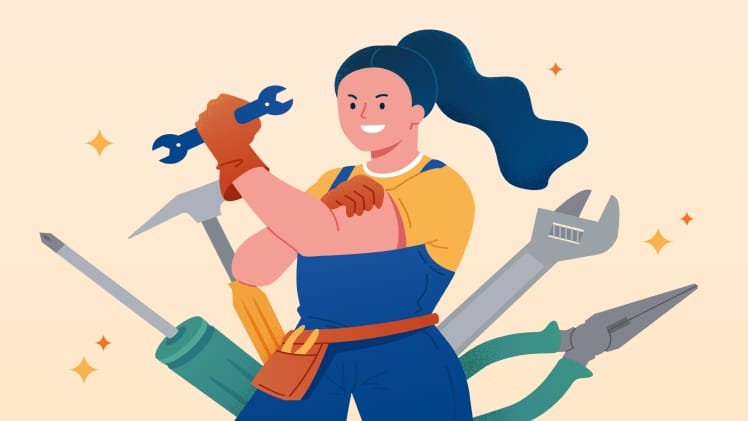
When calling for a plumber, most of us expect to welcome a man in a jumpsuit, carrying a big toolbox, ready to fix whatever plumbing problem we have. But, even if you don’t need a plumber to fix anything, if you only imagine one, it is most certainly a man.
A man bent underneath your kitchen sink with his pants riding low and revealing way, way too much.
Wouldn’t it be a surprise if, instead of opening your door to a man, you are greeted by a woman carrying the exact same toolbox and wearing the overalls, ready to fix your leak just as any other male plumber would?
In the U.S., there are some chances for that to happen. However, those chances are slim because, according to the U.S. Bureau of Labor data, only about 2.5% of all women decide to pursue a plumbing career.
Enormous Burden and Large Pushback
However, women who decide to become plumbers are not simply setting off on the road where only men walk. Making an impact in this ”man’s world” may be rewarding, but those women also have the responsibility of carving the road for other women who want to get into the trades. Tipping the scale in favor of women in a male-dominant industry is not an easy task.
Most of the women in the plumbing industry will tell you to expect an enormous pushback. Linda Hudek, owner and plumber at LH Plumbing Services, LLC, says that women ”need to be prepared for the pushback, especially if it’s not a family-owned business”.
It can also come from different sides, not just from fellow male plumbers in the industry. Many women have had issues with the customers refusing to let them do their job simply because they were women. However, it seems that the plumbing trade is well worth any aggravation it may cause to the women deciding to practice it.
As Leah Adelman, the owner of the Leah the Plumber, says, ”It’s a profession that’s well paid, and you can live a good lifestyle on what you make as a plumber”. According to the data, Leah is correct because the average salary for a plumber was $56,486 in the year 2019.
Depending on whether women are providing residential plumbing services or commercial plumbing services, they can earn a lot more.
Companies Who Don’t Hire Women Are Harming Only Themselves
One of the most significant obstacles of women in plumbing is set by the plumbing companies. Simply put, women are more likely to face rejection when applying to the job position at the company than any other male plumbing technician.
However, those companies don’t know they are doing more harm to themselves by not hiring any woman plumbers.
Alayna Chavez, a plumber from Florida, said that many of her customers feel more secure and comfortable with having a woman plumber fixing their plumbing issues than a male plumber.
Those customers are mostly older women and widows who dislike the aggressive tone most male plumbers have when trying to make a point. In this regard, women can not only bring the same plumbing skills to the industry but also bring some much-needed soft-communication skills.
Who Was The First Woman Plumber?
Surprisingly, the first woman master plumber in the United States was licensed back in 1951. A 21-year old Lillian Ann Baumbach Jacobs from Arlington, Virginia, took the master plumbers exam alongside six other men. Only Lillian and two other men passed.
While growing up, Lillian was always helping her father in his plumbing business which allowed her to be a trailblazer for the future generations of women.
More than 30 years later, in 1987, another legend of the plumbing industry decided to make it in the plumbing industry, and that was Adrienne Bennet, the first African American woman who became a master plumber in Detroit MI. To this day, she is an inspiration to many and a legend by being the CEO of her own company and being on the board of Lawrence Tech.
In 2019, she was named Small Business Women of the Year by the Small Business Association of Michigan.
